 Total Visitors
  Online Users
  Today
Today  Yesterday

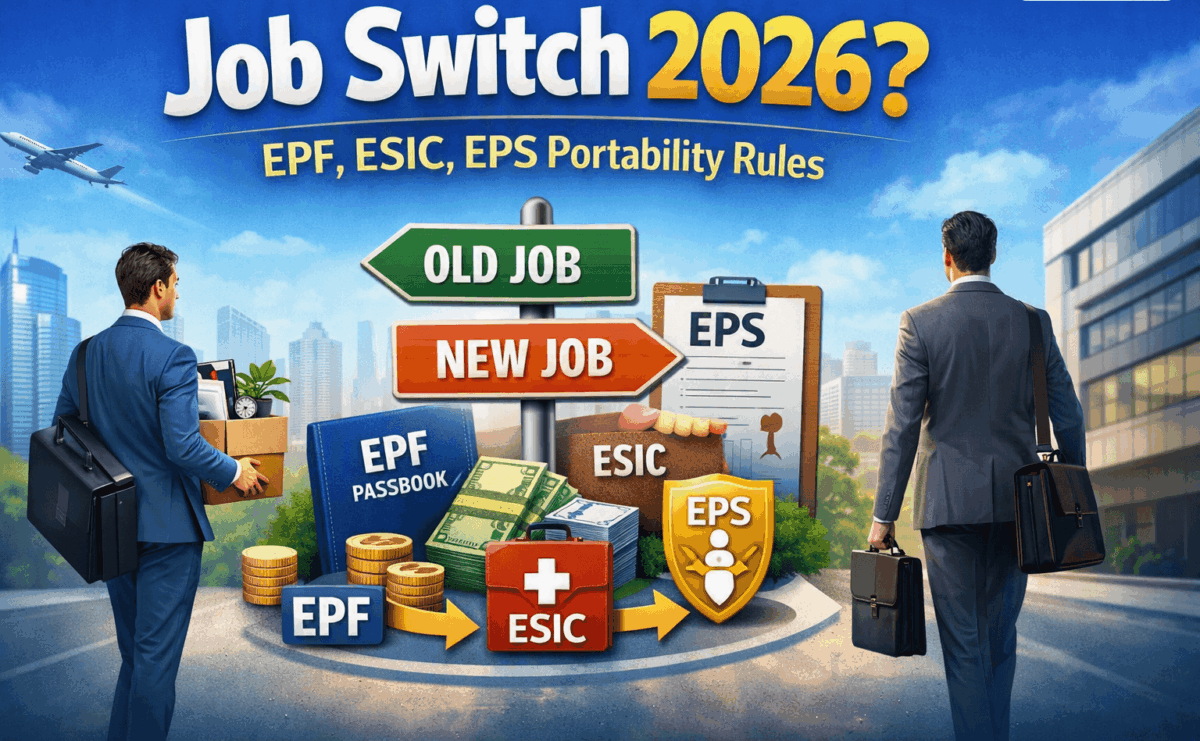
Statutory Genesis & Current Legal Posture
The apprehension regarding the portability of legacy social security registrations upon a mid-career job switch is both legitimate and pervasive. To address it with the precision it demands, we must first ground ourselves in the statutory reality of 2026. The legal architecture governing your EPF, ESIC, and EPS history is no longer a patchwork of disparate acts; it is now a consolidated framework under the Code on Social Security, 2020, which was brought into effect from 21 November 2025 .
Section 164 of the Code on Social Security, 2020 serves as the critical bridge. It is a transitional and savings provision that ensures the continuity of existing schemes, including the Employees’ Provident Funds Scheme, 1952, and the Employees’ Pension Scheme, 1995, until new rules are framed under the Code. This means your old LIN, ESIC, and EPS 1995 history have not been rendered obsolete. Instead, they are being systematically migrated into a unified, Aadhaar-linked digital ecosystem. The Ministry of Labour and Employment has explicitly operationalised this through the Unified Shram Suvidha Portal (USSP), which assigns a single Labour Identification Number (LIN) to every establishment, serving as a common identifier across EPFO and ESIC .
The key development is the introduction of EPS 2026, notified on 29 June 2026, which has replaced the older EPS 1995 . The fundamental criteria for pension eligibility remain unchanged. An employee is entitled to a monthly pension only upon completing a minimum of ten years of pensionable service . The formula for calculating the pension amount remains: (Pensionable Salary x Pensionable Service) / 70. The pensionable salary is capped at ₹15,000 for most employees. The portability of your service history is not merely a matter of convenience; it is the sole determinant of your eligibility for a lifetime pension.
Legacy Framework vs. Active/Transition Code Comparison
This comparison table delineates the specific parameters under the old statutes and the new operational framework, highlighting the practical impact on your job switch in 2026.
| Parameter | Legacy Framework (Pre-2026) | Active/Transition Framework (2026) | Practical Operational Impact |
| Central Registration | Multiple registrations (EPFO, ESIC) under different statutes. | Unified registration via the Shram Suvidha Portal, allotting a single LIN . | When you, as an employee, change jobs, your new employer will have their own LIN. That LIN is their establishment’s identifier on the Unified Shram Suvidha Portal. |
| Portability Mechanism | UAN was introduced but service transfer (EPS) often required a separate, manual process. | Universal Account Number (UAN) is mandatory and Aadhaar-linked, facilitating seamless transfer of EPF and EPS service history. | The new employer must link your existing UAN to their establishment; they cannot create a new UAN, ensuring all history is preserved. |
| EPS History Transfer | Often overlooked; employees focused on PF balance transfer, leaving EPS service fragmented . | Mandatory Transfer of EPS Service History. Employers are expected to attest the transfer request (Form 13) to ensure the employee’s total service is consolidated . | Your pension eligibility hinges on this. A missed transfer breaks the 10-year continuous service condition, leading to loss of pension rights . |
| Wage Ceiling (ESI) | ESI coverage was limited to establishments in notified areas with a wage ceiling of ₹21,000. | Universal applicability. Coverage is mandatory based on the new, unified definition of “wages” under Section 2(88) and a ceiling of ₹21,000 . | Your new employer must apply the correct wage structure. Even if your CTC is high, a misclassified salary structure could inadvertently bring you under ESI coverage . |
| Withdrawal Rules (EPS) | Withdrawal of EPS contribution was permitted after leaving service, though it resulted in a loss of pensionable service. | Withdrawal benefit under EPS 2026 requires a 36-month waiting period post last contribution, unless superannuation age is attained . Opting for a Scheme Certificate allows you to carry forward your service to a new job . | You cannot immediately withdraw your EPS money upon a job switch in 2026. You must wait 36 months, or choose the Scheme Certificate to protect your service history. |
Operational Implementation Framework for HR and Legal Teams
For corporate HR, payroll, and legal teams, the integration of a new employee from another establishment in 2026 is not a blank-slate onboarding process. It is a statutory duty to ensure the continuity of their social security entitlements.
Step 1: UAN Verification and LIN Integration. The onboarding workflow must begin with the validation of the new employee’s UAN. The employer must use this UAN to retrieve the employee’s service history. The establishment’s LIN, obtained through the USSP, will serve as the identifier to file the transfer request . Failure to verify the UAN can result in the creation of a duplicate account, a compliance infraction that will trigger a red flag during inspections.
Step 2: Transfer of EPF and EPS Service History (Form 13). The most critical step is filing the transfer request (Form 13) on the EPFO portal. This must be attested by the previous employer. The onus is on the current employer to ensure the request is processed and the EPS service history is reflected in the employee’s record. This is a non-negotiable step. Even if the EPF balance has been withdrawn, the EPS service history must still be transferred through Form 13 to protect pension eligibility . Inaction here results in statutory ineligibility for pension under EPS 2026.
Step 3: Salary Structure Audit and ESIC Applicability. The new employer’s payroll team must audit the employee’s salary structure against the Code on Social Security’s definition of “wages” (Section 2(88)) . The 50% rule for Basic + DA must be meticulously applied . The team must then determine ESIC eligibility based on gross wages, not just basic pay. For example, an employee with a Basic of ₹16,000 and HRA of ₹6,000 (gross ₹22,000) is not covered, while one with a Basic of ₹18,000 and HRA of ₹2,000 (gross ₹20,000) is.
Step 4: Contract Worker and Principal Employer Liability. If the employee is hired through a staffing agency, the new rules hold the principal employer ultimately responsible for compliance if the agency defaults. The principal employer bears secondary liability for ESIC/EPF compliance if the contractor defaults; immunity is expressly excluded. The principal employer cannot claim a shield of immunity. They are required to verify the ESIC and EPF compliance of the staffing agency for all contract workers.
Step 5: Documentation and DPDP Act Alignment. All consent and verification processes must align with the Digital Personal Data Protection (DPDP) Act. The employer must obtain explicit consent for processing Aadhaar and UAN-related data. Employees must be issued appointment letters, which are now mandatory and critical for establishing the date of employment for EPF and ESIC registration.
Step 6: Handling Overlapping Service Periods. The EPFO has clarified that overlapping service periods between jobs should not automatically disqualify a transfer claim . Form 13 should be submitted as usual, and supporting documents should be kept ready if clarification is requested.
Penal Consequences, Inspection Triggers, and Corporate Liability
The consequences of non-compliance under the 2026 regime are severe, and the government has introduced initiatives like the Amnesty Scheme 2025 and SPREE to encourage voluntary compliance, but this does not diminish the gravity of violations.
Inspection Triggers: The “Inspector-cum-Facilitator” model has transformed the inspection regime. Inspections are now risk-based and data-driven. Key triggers include: (a) systemic auto-detection of contribution gaps during half-yearly return reconciliation, (b) employee complaints of non-transfer of service, and (c) flagged misclassification of salary structures (violation of the 50% rule).
Financial Penalties and Interest: Late deposit of contributions attracts interest at 12% per annum from day one. Under the Amnesty Scheme 2025, defaulting employers were offered a one-time window to settle disputes without damages, but this is a limited window ending 30 September 2026. Beyond this, the compounding provisions and prosecution mechanisms under the new Code will apply. The appeal mechanism under Section 23 of the Code requires a 25% deposit of the amount due before an appeal can be entertained .
Corporate and Director Liability: The term “employer” has been expansively defined. Directors, occupiers, and principal employers can be held directly liable for violations. The prosecution provisions, while recalibrated, still hold the corporate entity and its officers accountable for systemic failures.
Strategic Advisory and Edge Cases
Inter-State Transfers: The UAN and LIN are centralised, making inter-state transfers seamless. However, state-specific rule adoptions remain a friction point, particularly under the Occupational Safety Code. It is crucial to verify whether the state has notified the relevant rules .
Gig and Platform Workers: For the first time, gig and platform workers are entitled to social security benefits. Aggregator platforms must contribute a share of their turnover to a social security fund. If you are moving from a traditional corporate role to a gig platform, your existing EPF/EPS history may not be directly transferable to the new fund created for these workers, which is a critical regulatory gap to monitor.
Fixed-Term Employment (FTE): The new codes formalise FTE. An employee on an FTE contract is entitled to gratuity after just one year of service, a significant change from the previous five-year requirement.
Scheme Certificate as Protection: Members who leave service before completing 10 years of eligible service can obtain a Scheme Certificate under EPS 2026 . This certificate preserves the eligible service already rendered. If the member joins another EPF-covered establishment in the future, the previous eligible service can be counted towards pension eligibility.
Disclaimer: The information and analysis provided in this document constitute statutory commentary and operational analysis based on notifications published by the Ministry of Labour & Employment, EPFO, ESIC, and other relevant government authorities up to the current date in 2026. This content is for informational and academic purposes only and does not constitute formal legal advice or create a lawyer-client relationship. The legal landscape is dynamic, and specific facts and circumstances can materially alter outcomes. Readers are strongly advised to consult a qualified legal professional to obtain advice tailored to their specific situation before making any decisions or taking any action.