

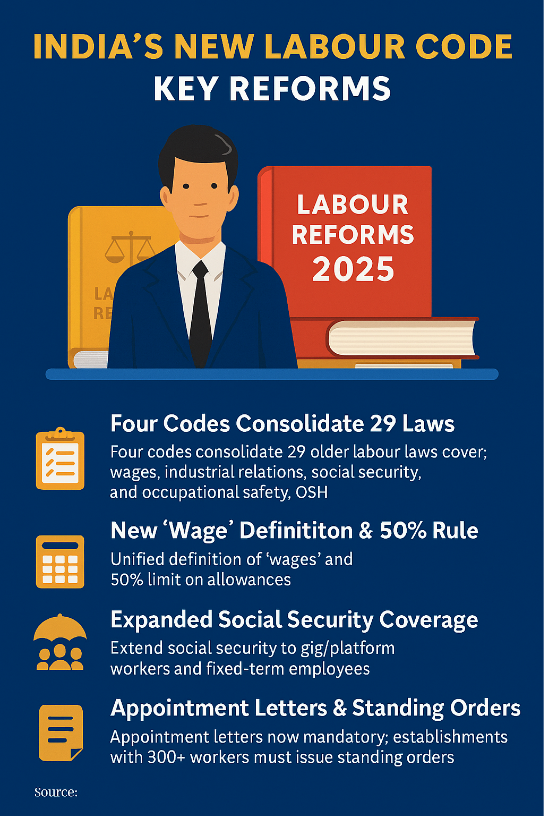
In a landmark move, the Hon’ble Modi government has implemented the four new Labour Codes from 21 November 2025, replacing 29 archaic labour laws with a streamlined, modern framework. These codes covering wages, industrial relations, social security, and occupational safety aim to simplify compliance, expand worker protections, and align India’s labour ecosystem with global standards. For employers, HR teams, and legal consultants, this reform demands immediate restructuring of salary components, employment contracts, and compliance protocols. This blog breaks down the key changes, statutory references, and actionable steps for businesses navigating the new labour regime.
1. Overview of the Four Labour Codes
Code on Wages, 2019
- Consolidates: Payment of Wages Act, Minimum Wages Act, Bonus Act, Equal Remuneration Act
- Introduces: Uniform wage definition, timely payment mandates, gender pay equity.
Industrial Relations Code, 2020
- Consolidates: Trade Unions Act, Industrial Employment (Standing Orders) Act, Industrial Disputes Act
- Introduces: Fixed-term employment, streamlined dispute resolution, mandatory appointment letters.
Code on Social Security, 2020
- Consolidates: EPF Act, ESIC Act, Maternity Benefit Act, Gratuity Act, Unorganised Workers’ Social Security Act
- Introduces: Universal social security, gig/platform worker coverage, digitized registration.
OSH Code, 2020
- Consolidates: Factories Act, Mines Act, Contract Labour Act, and others
- Introduces: Single license for multiple locations, safety audits, working hours cap.
2. Wage Definition and the 50% Rule
The Code on Wages introduces a uniform definition of “wages” under Section 2(y):
- Includes: Basic Pay, Dearness Allowance, Retaining Allowance
- Excludes: HRA, conveyance, overtime, bonus, commissions but only up to 50% of total remuneration.
50% Rule:
If excluded components exceed 50%, the excess must be added back to “wages” for compliance.
Impact:
- PF, ESIC, Gratuity, Bonus — all calculated on revised “wages”
- Employers must restructure salary to ensure Basic + DA ≥ 50% of CTC
3. Mandatory Appointment Letters and Standing Orders
Under the Industrial Relations Code:
- All employees including fixed-term and contract workers must receive appointment letters
- Establishments with ≥300 workers must issue standing orders
- Fixed-term employees now eligible for gratuity after 1 year
4. Universal Social Security and Gig Worker Coverage
The Social Security Code expands coverage to:
- Gig workers
- Platform workers
- Unorganised sector workers
Key Features:
- Aadhaar-based registration
- Digital contribution tracking
- Aggregators (e.g., Uber, Zomato) must contribute to social security funds
5. OSH Code: Safety, Licensing, and Working Hours
The OSH Code introduces:
- Single registration for multiple locations
- Working hours capped at 8/day and 48/week
- Annual health check-ups for hazardous occupations
- Women allowed to work night shifts with consent and safety measures
6. Penalties for Non-Compliance
Under the new codes:
- Penalties range from ₹10,000 to ₹3,00,000
- Repeat violations attract higher fines and imprisonment
- Digital inspections and audit trails are mandatory
Final Takeaway
The New Labour Codes represent a tectonic shift in India’s employment law.
For businesses, this is not just a legal update it’s a strategic imperative.
What Employers Must Do:
- Restructure salary components
- Issue appointment letters to all staff
- Register gig/platform workers
- Update HR policies and compliance checklists
- Train HR teams on new definitions and thresholds
The future of work in India is here and it is compliant, digitized, and worker-centric.
Join the Conversation
Your thoughts matter. Share your perspective in the comments—healthy dialogue helps us all understand labour law better.
Need Guidance?
Feel free to book a consultation. Expert advice can make compliance smoother and more effective.
Spread the Knowledge
If you found this article useful, don’t keep it to yourself—share it with colleagues, friends, or on social media. Together, we can build greater awareness of labour rights and responsibilities.
Disclaimer – This blog post is a general guide. It should not be considered legal advice. Consult a legal professional for more details.