

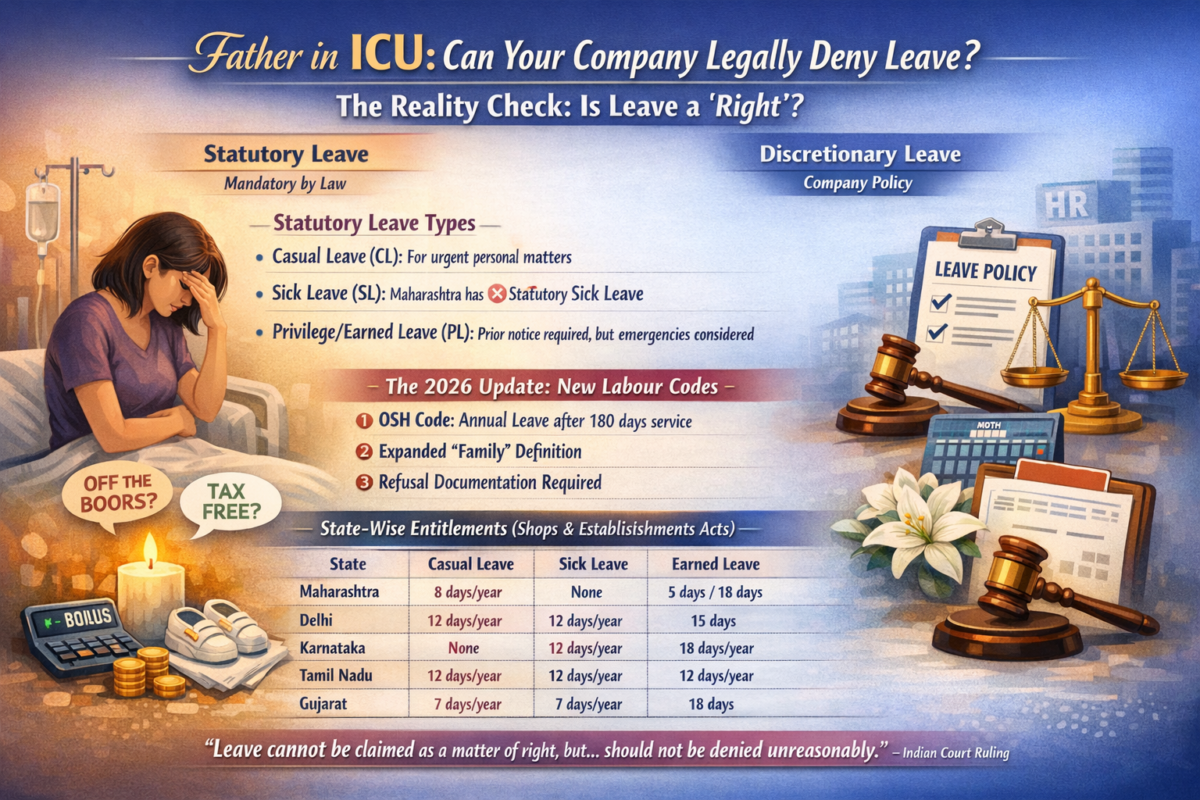
The Reality Check: Is Leave a “Right”?
Indian labour law divides leave into two categories:
- Statutory Leave – mandated by law under the Shops & Establishments Acts or the Factories Act.
- Discretionary Leave – additional leave offered by companies as part of their internal policies.
Statutory Leave Types
- Casual Leave (CL): For unforeseen or urgent personal matters.
- Sick/Medical Leave (SL): Primarily for personal illness, though some states and company policies extend this to dependent care. Maharashtra notably has no statutory sick leave.
- Privilege/Earned Leave (PL/EL): Requires prior notice, but employers are expected to act reasonably in emergencies. In Maharashtra, PL accrues as 5 days for every 60 days worked or 18 days for every 240 days worked.
Key Point: Leave is not an absolute right. Employers may refuse specific leave types if business continuity is at risk, but refusal must not be unreasonable or amount to harassment.
Current Status: The New Labour Codes (2026 Update)
With effect from November 21, 2025, the four Labour Codes replaced 29 legacy laws. Relevant changes include:
- Occupational Safety, Health and Working Conditions (OSH) Code, 2020
- Annual leave entitlement after 180 days of service.
- Carry-forward capped at 30 days, with mandatory encashment beyond this.
- Expanded Definition of “Family”
- Broader coverage under social security provisions.
- While “Emergency Leave” is not a statutory category, the Codes emphasize work-life balance.
- Refusal Documentation
- If leave is refused, the balance must be carried forward or encashed.
- Employers must record refusals, ensuring transparency.
Ready Reckoner: State-Wise Leave Entitlements (Shops & Establishments Acts)
| State | Casual Leave (CL) | Sick Leave (SL) | Privilege/Earned Leave (PL/EL) | Carry Forward Limit |
| Maharashtra | 8 days/year | ❌ No statutory sick leave | 5 days (for every 60 days worked) / 18 days (for every 240 days worked) | Max 42 days |
| Delhi | 12 days/year | 12 days/year | 15 days (after 12 months of continuous service) 5 days (after 4 months of continuous service) | Max 45 days |
| Karnataka | ❌ No statutory casual leave | 12 days/year | 18 days/year (one day for every twenty days’ work) | Max 45 days |
| Tamil Nadu | 12 days/year | 12 days/year | 12 days (after twelve months of continuous service) | Max 45 days |
| Gujarat | 7 days/year | 7 days/year | 18 days (after 240 days of continuous service) | Max 63 days |
Notes:
- Maharashtra is unique: no statutory sick leave under its Shops & Establishments Act. Employees must rely on CL or PL for emergencies.
- PL accrual in Maharashtra is formula-based.
- Employers may offer more generous policies, but cannot reduce below statutory minimums.
Myth vs Reality
| Myth | Reality |
| Emergency Leave is a legal right in India. | There is no statutory category called “Emergency Leave.” Employees must rely on CL or PL. |
| Employers can deny leave without explanation. | Under the Labour Codes, refusals must be documented and balances carried forward or encashed. |
| Sick Leave is available in all states. | Maharashtra has no statutory sick leave; employees must use CL or PL. |
| Leave can be claimed as an absolute right. | Courts have held: “Leave cannot be claimed as a matter of right, but it should not be denied unreasonably.” |
| WhatsApp messages don’t count legally. | Digital communications (email, WhatsApp) are admissible evidence in Indian courts. |
What to Do if Your Leave Is Denied
If your father is in the ICU and your manager or HR refuses leave:
- Create a Paper Trail
- Send an email or WhatsApp message (admissible in court).
- Use clear terms: “Critical Emergency,” “Father in ICU,” “Life-and-death situation.”
- Attach proof: hospital admission form or doctor’s note.
- Invoke the Casual Leave Clause
- Remind HR that CL is specifically meant for unforeseen exigencies.
- State Acts (e.g., Maharashtra, Delhi, Karnataka) protect the right to use CL for family emergencies.
- Escalate Internally
- Approach the HR Head or Internal Grievance Committee.
- Many companies have Compassionate Leave policies, even if managers are unaware.
Judicial Precedent
Indian courts have consistently held:
- “Leave cannot be claimed as a matter of right, but it should not be denied unreasonably, especially in cases of medical necessity.”
Bottom Line
- No statutory “Emergency Leave” exists.
- Employees can rely on Casual Leave or Privilege Leave accruals for urgent family situations.
- Employers may refuse leave, but refusal must be reasonable, documented, and non-harassing.
- The new Labour Codes emphasize work-life balance and strengthen transparency, though they stop short of codifying emergency leave.
Disclaimer:
This content is for educational and informational purposes only and does not constitute formal legal advice. Labour laws in India can vary by state and specific industry. For specific legal disputes, please consult with a qualified legal professional or a Labour Law Consultant.