

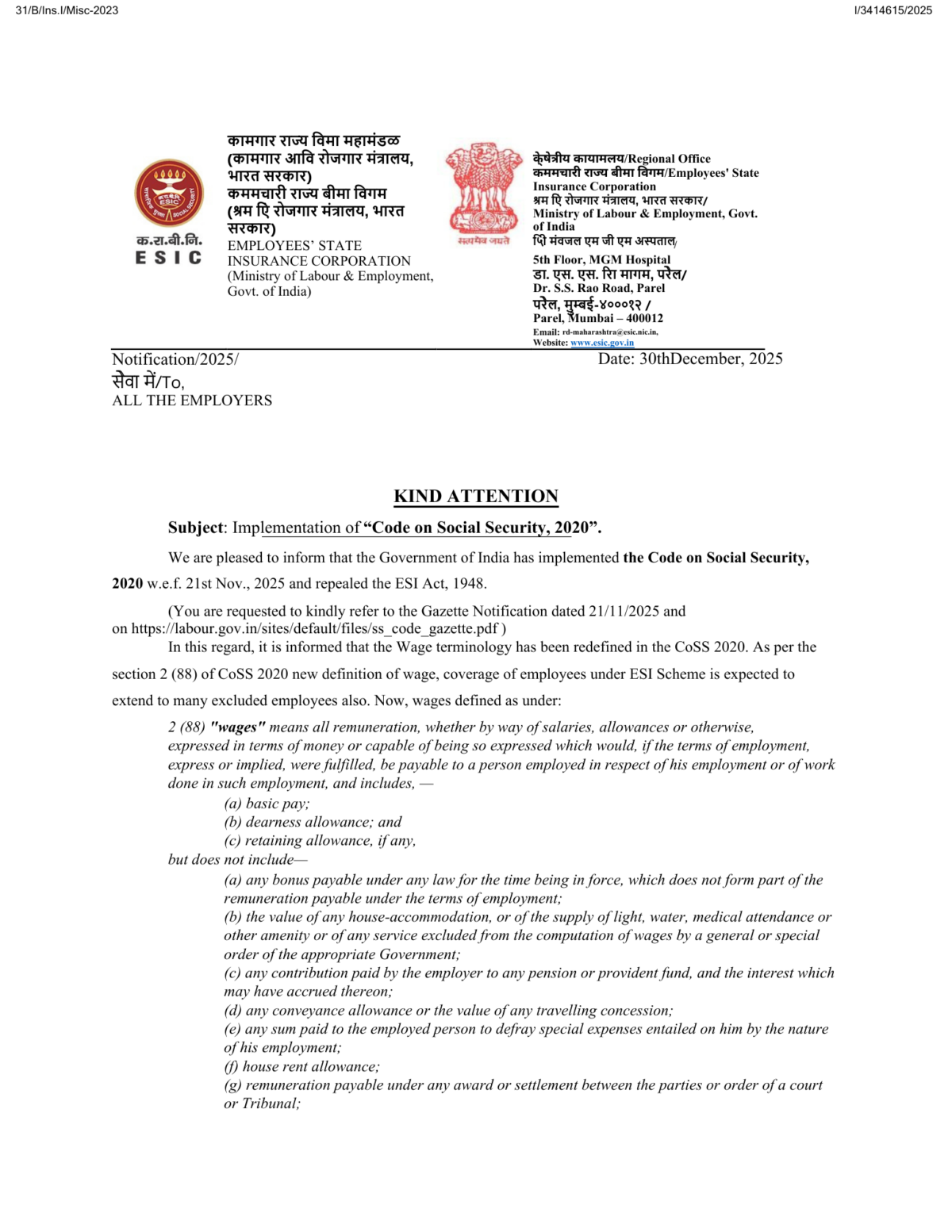
I still remember sitting across from a CFO in late 2025, watching him shuffle nervously through a payroll sheet. His team had built an allowance-heavy salary structure years ago, confident it would keep ESIC liability at bay. Then came the 30 December 2025 notification. Silence in the room. The Code on Social Security had finally stepped in, and the old ESI Act logic was gone.
That moment told me one thing: employers who cling to outdated interpretations are setting themselves up for inspection headaches.
What’s Really Changed
The Code on Social Security, 2020 (CoSS) isn’t just a new statute—it’s a new way of thinking about wages.
- Governing law: ESI Act, 1948 → replaced by CoSS, 2020
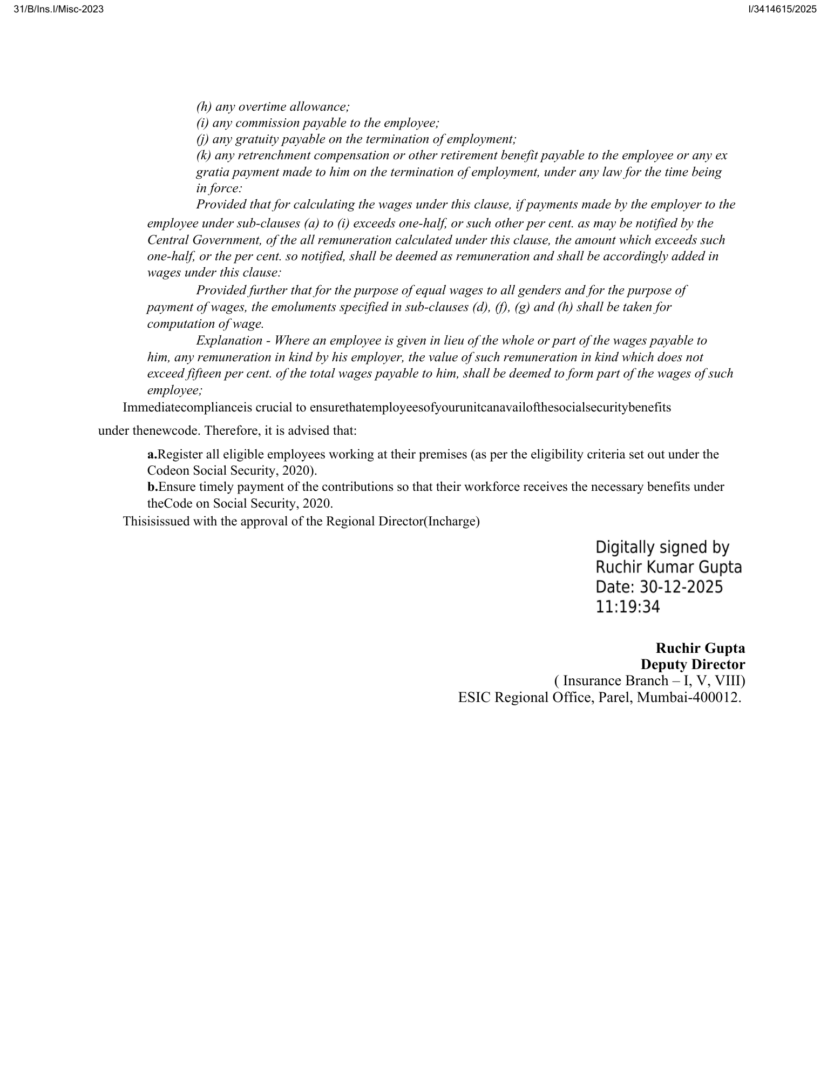
- Wage definition: Practice-driven → statutory definition with a 50% cap on exclusions
- Allowance structuring: Flexible → now structurally constrained
- Coverage: Static → directionally expanding
Inline reference: In the one-pager “Board / Audit Committee One-Pager,” the ESIC wage base jumped from ₹36,000 to ₹28,000 in an allowance-heavy example, simply because exclusions breached the 50% cap.
Why Employers Can’t Ignore This
- Allowance-heavy structures are vulnerable. What looked clever in 2019 is risky in 2026.
- Coverage will expand. Employees earlier outside ESIC may now fall within coverable wages.
- Legacy interpretations won’t hold. Inspectors will apply Code-centric logic, not Act-era practices.
Blockquote Citation:
“If allowances exceed 50% of total remuneration, the excess must be added back into wages.” — Ministry of Labour FAQs
Practical Examples
Example 1: Allowance-heavy salary
- Gross: ₹40,000
- Old ESIC base: ₹36,000 (excluded conveyance)
- Code-based ESIC base: ₹28,000 (after deemed additions)
- Impact: Employee may now be coverable.
Example 2: Balanced salary
- Gross: ₹40,000
- Exclusions within 50% cap
- ESIC exposure: Minimal change
Takeaway: ESIC wages aren’t automatically 50% of gross. But the ability to suppress wages through exclusions is gone.
Recommended Employer Posture
- Maintain compliance with current filings.
- Document wage rationale—don’t wait for inspectors to ask.
- Prepare payroll systems for Code-based computation.
- Avoid aggressive structuring in new compensation designs.
Bottom line: This is a transition phase, not a disruption phase. Treat it as a preparation window.
Don’t wait for inspectors to knock. Review your wage structures now, document your rationale, and prepare payroll systems for Code-based ESIC compliance.
References
- Section 2(y), Code on Wages, 2019 – India Code
- Ministry of Labour & Employment FAQs on Labour Codes – labour.gov.in
- Press Release, Government of India Notification dated 21 November 2025 – PIB
Join the Conversation
Your thoughts matter. Share your perspective in the comments—healthy dialogue helps us all understand labour law better.
Need Guidance?
Feel free to book a consultation. Expert advice can make compliance smoother and more effective.
Spread the Knowledge
If you found this article useful, don’t keep it to yourself—share it with colleagues, friends, or on social media. Together, we can build greater awareness of labour rights and responsibilities.
Disclaimer – This blog post is a general guide. It should not be considered legal advice. Consult a legal professional for more details.