

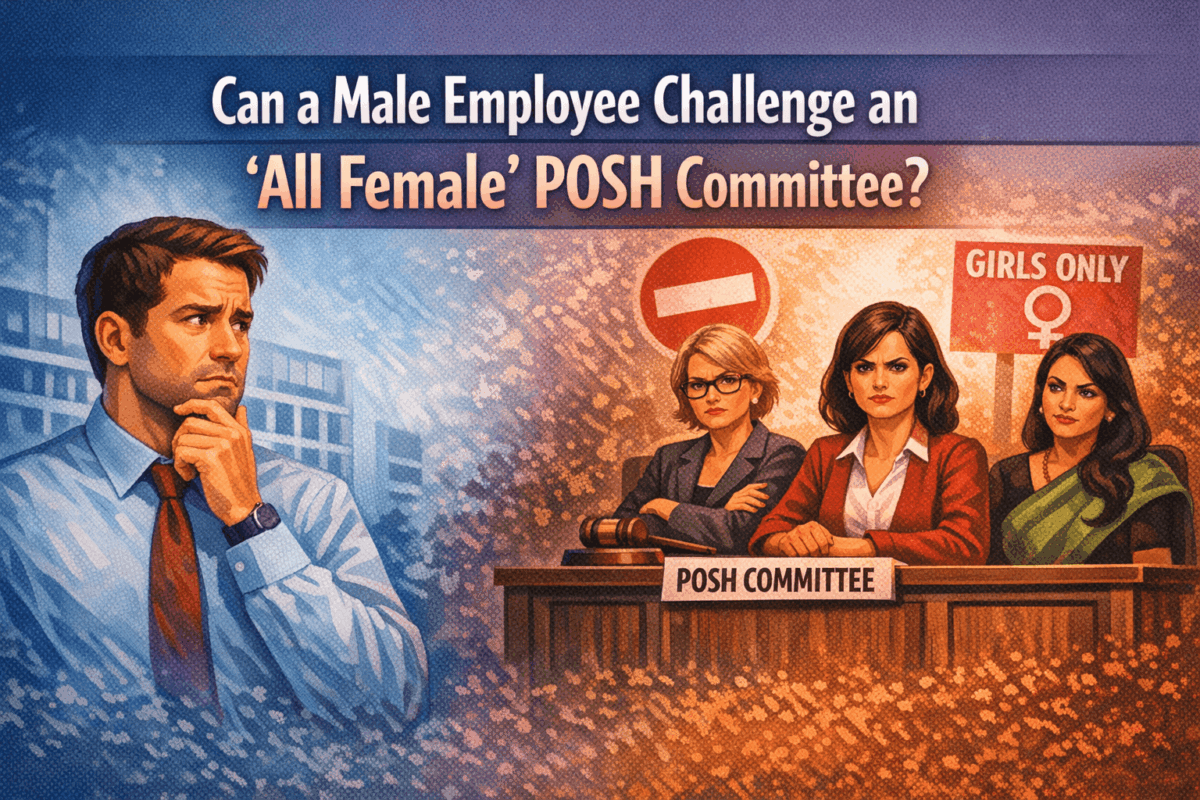
“Is it fair that I’m being judged by a committee with zero male representation?”
This is a question often whispered in the corridors of Indian corporates. When a male employee is accused of sexual harassment, his first instinct is often to look for bias. He might feel that an all‑female Internal Committee (IC) will naturally be sympathetic to the complainant and hostile toward him.
But does this feeling of “unfairness” translate into a legal right to complain or challenge the committee’s formation? In the 2026 legal landscape, the answer depends entirely on whether your organization followed the composition math of the POSH Act or ignored diversity altogether.
1. The Legal Verdict: Is “All‑Female” Illegal?
The short answer is No. An all‑female committee is technically 100% legal.
Under Section 4 of the POSH Act, 2013, the law mandates:
- Presiding Officer: Must be a senior woman employee. (Section 4(2)(a))
- Female Representation: At least one‑half of the total members must be women. (Section 4(2))
The Act sets a minimum requirement for female representation, but it does not set a maximum. Therefore, an employer has the legal discretion to nominate an all‑female committee. A male employee cannot challenge the IC solely on the grounds that it has no men.
2. When CAN a Male Employee Complain?
While gender mix itself isn’t a ground for challenge, a male respondent can challenge the IC’s formation under the Principles of Natural Justice if he can prove institutional bias.
Grounds for challenge include:
- Conflict of Interest: A member is a direct subordinate or close personal associate of the complainant.
- Pre‑judged Mindset: A member has made public statements or internal communications indicating guilt before inquiry.
- Procedural Lapses: The IC lacks a senior woman Presiding Officer or a truly independent External Member.
Key4Comply’s Expert Insight: Indian courts have clarified that the External Member must be truly independent under Section 4(2)(c) of the POSH Act. In Ruchika Singh Chhabra v. M/S. Air France India & Anr. (Delhi High Court, 2018), the IC was challenged because the External Member lacked NGO association and clear qualifications. The Court held that this violated the statutory requirement and undermined the committee’s credibility. Similarly, High Court commentary in later cases has emphasized that appointing insiders such as company lawyers on retainer or ex‑employees compromises neutrality. While no judgment has said “company lawyer = invalid IC” in so many words, courts have consistently disapproved of such appointments where independence is questionable.
Compliance Takeaway: In 2026, High Courts are increasingly strict about the External Member’s independence. If your External Member is not demonstrably neutral and qualified, the respondent can challenge the IC for lack of statutory compliance and institutional bias.
3. The “Bias” Argument in Indian Courts
Indian courts have not treated all‑female ICs as inherently biased against men. Challenges succeed only if bias or procedural lapses are proven.
Still, to ensure inquiry reports survive judicial scrutiny, progressive organizations in 2026 are moving toward balanced committees.
Why Include Men?
- Inclusion: Prevents an “Us vs. Them” narrative in the workplace.
- Due Process: Demonstrates fairness for respondents, not just box‑ticking compliance.
- Sensitization: Male members can help contextualize workplace dynamics and educate peers during awareness sessions.
4. 2026 Compliance: Legacy Laws vs. New Codes
While the POSH Act remains the primary legislation, the Industrial Relations (IR) Code, 2020 (fully active in 2026) emphasizes fair disciplinary procedures.
If a male employee is terminated based on an IC report from a “biased” committee, he may seek relief under the IR Code for unfair dismissal.
| Factor | POSH Act (Current) | IR Code (Interplay) |
| Focus | Protection of Women | Fairness of Service Termination |
| Composition | Min 50% Women | N/A (Relies on POSH) |
| Appeal Ground | Statutory Defect | Violation of Natural Justice |
5. FREE – Summary Checklist for HR: The “Challenge‑Proof” IC
- [ ] 50% Rule: Ensure at least half of IC members are women.
- [ ] Minimum Size: Do you have at least 4 members (Presiding Officer + 2 internal + 1 external)?
- [ ] Independence Audit: Is your External Member truly an outsider?
- [ ] Bias Screening: Have members signed a “No Conflict of Interest” declaration for each case?
- [ ] Training: Are male members trained in gender sensitivity to avoid inadvertent bias?
Disclaimer: This article is for educational and informational purposes only and does not constitute legal advice. Legal outcomes depend on specific facts and judicial discretion. Always consult a qualified legal professional for case‑specific guidance.