 Total Visitors
  Online Users
  Today
Today  Yesterday

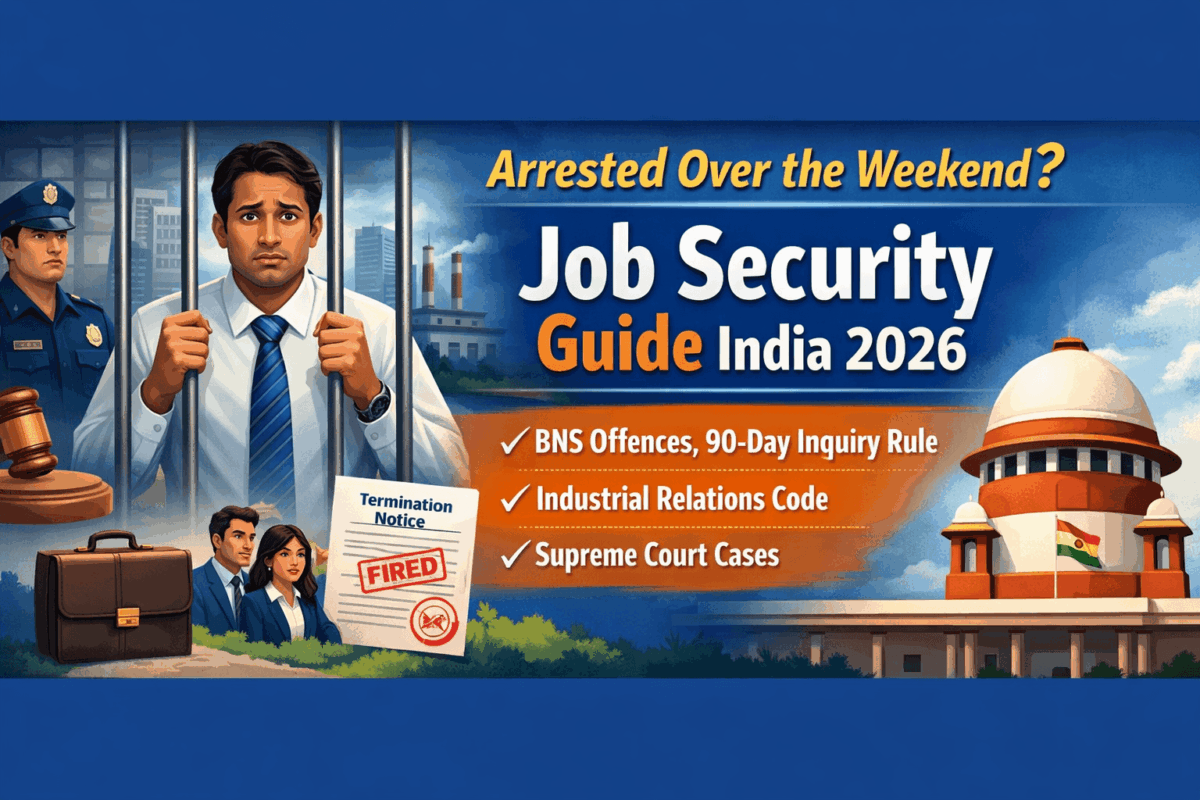
Introductory Note
Respect for law and order is paramount. This guide is intended solely for informational purposes. It does not promote or encourage any wrongful conduct, misconduct, or moral turpitude. The content aims to provide clarity on legal and employment matters without encouraging unlawful behaviour. If you find yourself in a situation involving legal proceedings, always consult a qualified legal professional. Laws change – this guide reflects the position as of May 2026.
The Disclosure Dilemma
What does the law require?
Indian labour law does not mandate that employees automatically report an arrest to their employer. No central labour statute – including the Industrial Relations Code, 2020 – imposes a statutory duty of automatic arrest disclosure.
What do employment contracts say?
Most companies include disclosure obligations in their Code of Conduct or Ethics Policy:
| Employment Type | Disclosure Expectation |
|---|---|
| IT, Banking, Manufacturing | Often require informing HR within 24–48 hours of any arrest or criminal proceeding |
| Government / PSU | Subject to CCS (CCA) Rules, 1965 (see 48‑hour rule below) |
| Smaller / Unorganised Sector | May not have formal disclosure policies |
What is the risk of silence?
If you fail to disclose and the company later discovers the arrest (via background verification or media reports), termination for suppression of material facts or breach of trust becomes legally defensible. The Supreme Court in Avtar Singh v. Union of India (2016) held that suppression must be evaluated for materiality – not every non‑disclosure automatically disqualifies employment.
The Supreme Court further clarified in Ravindra Kumar v. State of U.P. (22 February 2024):
“Broad‑brushing every non‑disclosure of a criminal case (in which the candidate is acquitted) as a disqualification from recruitment will be unjust. Each case will depend on the facts and circumstances, and the Court will have to take a holistic view.”
Can They Fire You? The Legal Reality
The governing framework
The Industrial Relations Code, 2020 (Chapter X, Sections 78‑80) consolidates rules on lay‑off, retrenchment, closure, and misconduct. However, for dismissal based on misconduct, a domestic inquiry is still mandatory.
Misconduct vs. Moral Turpitude
| Concept | Meaning | Examples |
|---|---|---|
| Misconduct | Violation of workplace rules / behaviour | Tardiness, insubordination, negligence |
| Moral Turpitude | Conduct that is inherently base, vile, depraved or having any connection showing depravity | Fraud, dishonesty, theft, grave violence |
Minor Offences – BNS 2023 Update
The Bharatiya Nyaya Sanhita, 2023 (BNS) has replaced the Indian Penal Code, 1860. Relevant equivalents:
| Offence | Old IPC | New BNS | Punishment |
|---|---|---|---|
| Affray (public brawl) | Section 160 | Section 194(2) | Imprisonment up to 1 month or fine up to ₹1,000 or both |
| Voluntarily causing hurt | Section 323 | Section 115(2) | Imprisonment up to 1 year or fine up to ₹10,000 or both |
| Obscene acts / songs | Section 294 | Section 296 | Imprisonment up to 3 months or fine up to ₹50,000 or both |
A weekend scuffle or affray (BNS Section 194(2)) or simple hurt (BNS Section 115(2)) generally does not amount to moral turpitude. The Supreme Court in State of Haryana v. Ved Kaur (2017) held that a conviction under Section 323 IPC (now BNS 115(2)) does not, by itself, amount to moral turpitude. Similarly, Pawan Kumar v. State of Haryana (1996) held that Section 294 IPC (obscene acts) is not an offence involving moral turpitude.
Termination without a domestic inquiry for such minor incidents could be challenged as illegal retrenchment.
The 48‑Hour Rule (Government/PSU)
Under Rule 10(2)(a) of the Central Civil Services (CCA) Rules, 1965:
A government servant is deemed to have been placed under suspension with effect from the date of detention, if he is detained in custody on a criminal charge for a period exceeding 48 hours.
Private companies are not statutorily required to follow this rule, though they may adopt similar policies contractually.
How the New Labour Codes Change the Game (May 2026 Update)
What the Industrial Relations Code, 2020 does
- Model Standing Orders, 2026: Under the Industrial Relations (Central) Rules, 2026 (notified on 8 May 2026), establishments with 300+ workers must adopt Model Standing Orders, 2026, which prescribe uniform definitions of misconduct, classification of workmen, and disciplinary procedures for the mining, manufacturing, and services sectors.
- 90‑day inquiry timeline: Under the Model Standing Orders, 2026, investigations and inquiries after suspension must be completed within 90 days from the date of suspension. The provision states: “Such investigation or enquiry or where there is an investigation followed by enquiry, both the investigation and enquiry shall ordinarily be completed within ninety days from the date of suspension”.
- Subsistence allowance: Suspended employees are entitled to 50% of wages for the first 90 days of suspension, and 75% for the remaining period if the delay is not attributable to the worker. The Model Standing Orders specify payment at the rate of fifty per cent of wages last drawn for the first ninety days of suspension, and at the rate of seventy-five per cent of such wages for the remaining period, if delay in completion of proceedings is not directly attributable to the conduct of such worker.
- Penalty for non‑compliance: Section 86(1) of the IR Code, 2020 provides that an employer who contravenes Sections 78, 79, or 80 (relating to lay‑off, retrenchment, closure, and misconduct) shall be punishable with a fine of not less than ₹1 lakh, up to ₹10 lakh.
What the Code does not do
- It does not eliminate the requirement for domestic inquiry before dismissal for misconduct. Natural justice principles continue to apply.
- Arbitrary termination without inquiry remains unlawful.
- The Code does not prescribe a “deemed reinstatement” if the 90‑day timeline is breached; however, employers must pay a higher subsistence allowance (75%) for delays not attributable to the worker, and the employee has a right to appeal the suspension to the designated appellate authority under the Model Standing Orders, 2026.
Confession Admissibility (Bharatiya Sakshya Adhiniyam, 2023)
Under the Bharatiya Sakshya Adhiniyam, 2023 (BSA) which replaced the Indian Evidence Act, 1872:
- Section 25 BSA: A confession made to a police officer is not admissible in a criminal trial.
- Section 26 BSA: No confession made while in police custody is admissible unless made in the immediate presence of a magistrate.
- Section 27 BSA: Only that part of information given by accused that leads to discovery of a fact is admissible.
However, departmental proceedings (domestic inquiries) are not bound by the strict rules of evidence under BSA. Admissions made to employers may still be admissible in internal disciplinary proceedings, depending on the employer’s standing orders and natural justice principles.
Legal References Appendix (Updated May 2026)
| Law / Case | Section / Rule | Principle Established | Application |
|---|---|---|---|
| Bharatiya Nyaya Sanhita, 2023 | Section 115(2) | Voluntarily causing hurt – imprisonment up to 1 year or fine up to ₹10,000 or both | Minor off‑duty hurt does not amount to moral turpitude |
| Bharatiya Nyaya Sanhita, 2023 | Section 194(2) | Affray – imprisonment up to 1 month or fine up to ₹1,000 or both | Minor public scuffle not grounds for dismissal |
| Bharatiya Sakshya Adhiniyam, 2023 | Sections 25‑27 | Confession to police not admissible; custody confessions require magistrate presence | Distinction between criminal and departmental proceedings |
| Industrial Relations Code, 2020 | Sections 78‑80, Chapter X | Termination for misconduct requires due process | Off‑duty misconduct requires domestic inquiry |
| Industrial Relations (Central) Rules, 2026 | Rules 21‑28; 40(1)‑(2) | Model Standing Orders notified; complaint procedure for aggrieved employees | Framework for disciplinary procedure |
| Model Standing Orders, 2026 | Standing Order 24 (suspension & discipline clauses) | Inquiry to be completed within 90 days; 50% subsistence allowance for first 90 days, 75% thereafter | Suspension procedural framework with subsistence allowance progression |
| Industrial Relations Code, 2020 | Section 86(1) | Penalty for contravening Sections 78‑80 | Fine not less than ₹1 lakh, up to ₹10 lakh |
| Code on Social Security, 2020 | Section 124 | Employer cannot reduce wages due to increased statutory liability | Protection against pay cuts due to Code compliance |
| Central Civil Services (CCA) Rules, 1965 | Rule 10(2)(a) | Government employee deemed suspended if custody >48 hours | Applies to PSU / Government staff |
| Ravindra Kumar v. State of U.P. (22 Feb 2024) | Supreme Court | Broad‑brushing non‑disclosure as disqualification unjust | Suppression must be evaluated contextually, especially for acquittals |
| Avtar Singh v. Union of India (2016) | Supreme Court | Suppression must be material; holistic assessment | Case‑by‑case determination of suppression’s impact |
| State of Haryana v. Ved Kaur (2017) | Supreme Court | Section 323 IPC (hurt) conviction does not amount to moral turpitude | BNS 115(2) – simple hurt not automatic disqualification |
| Pawan Kumar v. State of Haryana (1996) | Supreme Court | Section 294 IPC (obscene acts) not moral turpitude | BNS 296 – minor offences not moral turpitude |
| Delhi Transport Corporation v. DTC Mazdoor Congress (1991) | Supreme Court | Domestic inquiry and natural justice mandatory before dismissal | Arbitrary termination for minor incidents unlawful |
FREE – Quick Compliance Checklist (Employee Guide) – Updated May 2026
If You Are Arrested or Detained:
- Check Your Employment Contract / Code of Conduct – Look for clauses on mandatory disclosure of arrests or criminal proceedings. If disclosure is required, inform HR within the stipulated timeframe (usually 24–48 hours).
- Document Everything – Keep copies of FIRs, bail orders, or court documents. Written communication (email) with HR is admissible evidence if disputes arise.
- Assess the Nature of the Offence under BNS 2023 – Minor offences (affray – BNS 194(2), simple hurt – BNS 115(2)) generally do not amount to moral turpitude. Serious offences (fraud, dishonesty, grave violence) may justify dismissal.
- Know the 48‑Hour Rule – Applies statutorily to government/PSU employees (deemed suspension after 48 hours custody). Private companies are not mandated by law to follow this.
- Insist on Due Process – Employers must conduct a domestic inquiry before dismissal for misconduct. Under the Model Standing Orders, 2026, inquiries after suspension must be completed within 90 days; during suspension, you are entitled to 50% of wages for the first 90 days and 75% thereafter if the delay is not your fault.
- Seek Legal Counsel Early – If suspension or dismissal is threatened, consult a labour lawyer immediately. Case law supports employees where minor off‑duty incidents are used unfairly against them.
Bottom Line
| What You Should Know (as of May 2026) |
|---|
| No automatic dismissal for minor arrests |
| Disclosure obligations are contractual, not statutory |
| Moral turpitude is the threshold for dismissal; minor affray / simple hurt under BNS does not meet it |
| Labour Codes (2026) require due process – domestic inquiry and 90‑day inquiry timeline under Model Standing Orders, 2026 |
| Private companies are not mandated to follow the 48‑hour custody suspension rule |
| Penalty for violating IR Code Sections 78‑80: fine of ₹1 lakh to ₹10 lakh |
| Always seek legal advice – every case has unique facts |