 Total Visitors
  Online Users
  Today
Today  Yesterday

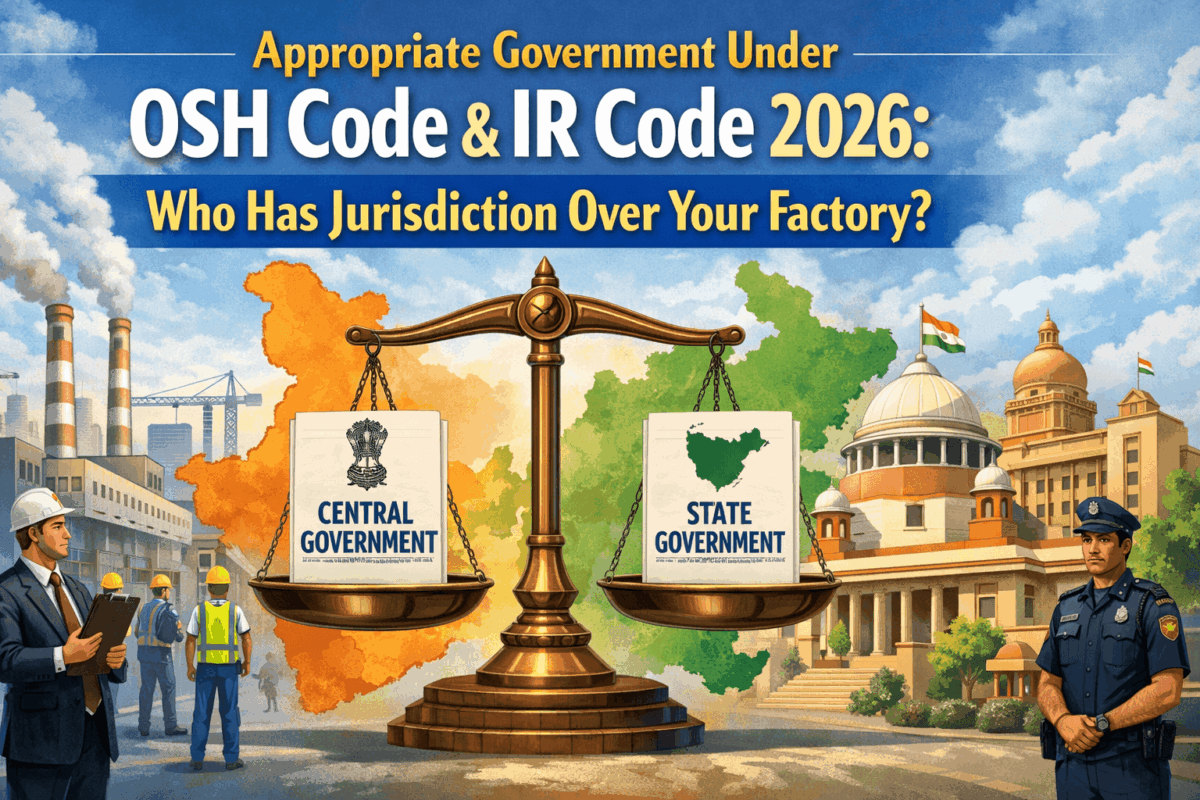
Your corporate headquarters are in Delhi. Your factory is in Haryana. Under the new Labour Codes, which state’s labour department has the final say on your standing orders, grievance committees, and retrenchment approvals?
This is not a trick question. But the answer has caught more than a few CXOs off guard since the Codes came into force on November 21, 2025. And with the Central Rules now notified on May 8, 2026, the compliance machinery is fully operational. Getting this wrong is no longer a theoretical risk; it is a live exposure.
Let me walk you through exactly how the jurisdictional map works under the new framework, using your Haryana-Delhi setup as the anchor. But more importantly, let me show you why this applies to any company with operations spread across state lines.
Why the “appropriate government” question keeps HR heads up at night
The Second National Commission on Labour explicitly recommended a single, uniform definition of “appropriate government” across all labour laws to avoid ambiguity and litigation. Parliament, however, took a different path.
The four Labour Codes do not speak with one voice on jurisdiction. The OSH Code, in particular, departs from the drafting pattern of the other three Codes by omitting a clear residuary clause. This has created a compliance puzzle that every multi-state employer now needs to solve.
The stakes are straightforward: the “appropriate government” determines which labour department you report to, which certifying officer approves your standing orders, which authority has jurisdiction over retrenchment, and where your workers file grievances. File with the wrong authority, and your compliance is effectively null and void.
The OSH Code: Haryana holds the pen
Under Section 2(1)(d)(ii) of the OSH Code, 2020, the State Government remains the appropriate authority for factories, motor transport undertakings, plantations, newspaper establishments, and establishments relating to beedi and cigar. The Code explicitly clarifies that the State Government shall be the appropriate Government in respect of occupational safety, health and working conditions in a factory situated in that State.
For your factory in Haryana, this means:
- Factory registration and annual returns go to the Haryana Labour Department
- Safety committee requirements are governed by Haryana rules
- Medical examination mandates fall under Haryana jurisdiction
- Working hours and welfare provisions are enforced by Haryana authorities
Delhi has no role here. Your corporate headquarters being in Delhi does not transfer an inch of OSH Code jurisdiction to the Delhi government.
Haryana moved early on this. On May 4, 2026, the state issued the Draft Haryana Occupational Safety, Health and Working Conditions Rules, 2026. The draft rules apply broadly to factories and introduce electronic registration, licensing, and compliance systems. Employers are required to maintain proper registers, records, and returns in prescribed formats. The deadline for objections and suggestions on the draft was June 19, 2026. As of July 2026, the final rules are still pending notification. The Haryana government has, however, already operationalised the registration framework and exempted OSH-registered establishments from separate Shop Act compliance.
The IR Code: Same principle, higher stakes
The IR Code, 2020, defines “appropriate Government” in Section 2(b). The Central Government is the appropriate government for establishments carried on by or under the authority of the Central Government viz. railways, mines, major ports, air transport, telecommunications, banking, and insurance companies.
For all other industrial establishments and your Haryana factory falls squarely in this category i.e. the State Government is the appropriate government.
Here is where the IR Code bites:
Standing Orders: Under Section 29 of the IR Code, industrial establishments employing 300 or more workers must prepare and submit draft standing orders. On May 8, 2026, the Central Government notified the Model Standing Orders, 2026, for the manufacturing, mining, and services sectors. The model standing orders are centrally framed under Section 29 of the IR Code, and employers can adopt them directly with deemed certification if no objections are raised within 30 days.
But here is the catch: the certifying officer who records the adoption and maintains the register is the one appointed by the State Government. For your factory, that is the Haryana certifying officer, not Delhi. The Industrial Relations (Haryana) Rules, 2026, were also released as a draft in early May 2026, and they will prescribe the state-level procedural framework.
Grievance Redressal Committees: The IR Code mandates GRCs for industrial establishments employing 20 or more workers. The IR Rules now prescribe the composition, tenure, representation requirements for women workers, timelines for filing and resolution, and the escalation mechanism. The appropriate government again, Haryana will have a say in how these committees operate within the state.
Retrenchment: Establishments with 300 or more workers require prior government
permission for retrenchment. The “appropriate Government” that grants this permission is the State Government i.e. Haryana in your case. You cannot approach the Delhi government for retrenchment approvals simply because your HQ is there. The Delhi labour department has no jurisdiction over industrial actions at your Haryana factory.
The Social Security Code exception: where the rules change
Here is where many companies get tripped up. Under the Code on Social Security, 2020, the Central Government is designated as the “appropriate government” for establishments operating in more than one State.
This means that for social security compliance viz. Provident Fund, ESI, gratuity, and other welfare measures; the Social Security (Central) Rules, 2026, will apply to your organisation since you have presence in both Haryana and Delhi.
But this is a specific exception carved out for the Social Security Code. It does not extend to the OSH Code or the IR Code. For safety, health, working conditions, industrial relations, standing orders, and retrenchment, the jurisdictional anchor remains the location of the establishment.
Central Rules vs. State Rules: who does what?
The Central Rules notified on May 8, 2026, provide the procedural and compliance framework for implementing the Labour Codes. But they are immediately relevant only for establishments for whom the Central Government is the “appropriate government”.
For your factory in Haryana, the Central Rules set the broad framework, but the Haryana State Rules will prescribe the detailed compliance requirements. This is the reality of labour being a Concurrent Subject under the Indian Constitution.
The interplay gets particularly interesting with the Model Standing Orders. While Section 29 of the IR Code suggests that the model standing orders are centrally framed, employers still need to examine the interplay between the IR Code, the applicable rules, and the “appropriate government” framework before treating the notification as mechanically applicable across all establishments.
In practical terms: the Model Standing Orders, 2026, give you the template. The Haryana certifying officer gives you the approval.
A real-world walkthrough: your Haryana factory
Let me put this together for your specific situation.
| Compliance Area | Your Appropriate Government | Why |
| OSH Code registration and filings | Haryana | OSH Code Section 2(1)(d)(ii) – State Government for factories |
| Standing orders certification | Haryana | IR Code – State Government for industrial establishments; certifying officer is state-appointed |
| Grievance Redressal Committee | Haryana | IR Code – State Government prescribes framework |
| Retrenchment approval | Haryana | IR Code – State Government grants permission for 300+ worker establishments |
| Social Security (PF, ESI, gratuity) | Central Government | SS Code – Central Government for establishments operating in more than one State |
Notice the pattern: for everything that touches your factory floor and your industrial relations on the ground, Haryana is the authority. Delhi only steps in for social security and that is because your organisation crosses state lines, not because your HQ is there.
The compliance checklist for multi-state employers [FREE]
- Identify all your establishments and their locations
- For each establishment, determine the “appropriate government” under each Code
- For factories, register under the OSH Code with the State Government where the factory is situated
- If employing 300+ workers, prepare standing orders and get them certified by the State certifying officer
- Constitute Grievance Redressal Committees as per the State rules
- For retrenchment, seek prior permission from the State government (if 300+ workers)
- For social security, follow the Central Social Security Rules, 2026, if operating in more than one State
- Track the final notification of State Rules in each jurisdiction where you operate
- Ensure all compliance documentation clearly identifies the correct appropriate government
The risk analysis: what happens if you get it wrong
| Risk Area | Consequence |
| Wrong registration authority | Registration deemed invalid; penalty provisions under OSH Code apply |
| Filing with wrong government | Returns treated as non-filed; penalty and interest on dues |
| Standing orders not certified by correct authority | Standing orders unenforceable; industrial disputes risk |
| Retrenchment without correct government approval | Retrenchment held illegal; reinstatement with back wages; penalties |
| Grievance filed with wrong authority | Delayed resolution; worker unrest; reputational damage |
The bottom line for your boardroom
Your appropriate government for OSH Code and IR Code compliance is the state where your establishment is situated i.e. Haryana for your factory. Delhi has jurisdiction only over your corporate office functions, not over factory operations, standing orders, grievance redressal, or retrenchment at your manufacturing facility.
The Social Security Code is the sole exception, where the Central Government steps in because you operate across multiple states.
The Central Rules are now in force. The State Rules are following. The compliance machinery is fully operational. If your current strategy assumes your HQ state has jurisdiction over your factory operations, it is time for a reset.
Get your filings right. Get your approvals from the right authorities. And if you have been dealing with the Delhi labour department for your factory compliance, redirect your efforts to Haryana before the inspector shows up.
Disclaimer: This content is for educational and informational purposes only and is based on available Central and State notifications as of July 2026. It does not constitute formal legal counsel. Readers are advised to consult qualified legal professionals for advice specific to their circumstances. Laws and rules are subject to change, and professional legal advice should be sought before taking any action based on this content.