 Total Visitors
  Online Users
  Today
Today  Yesterday

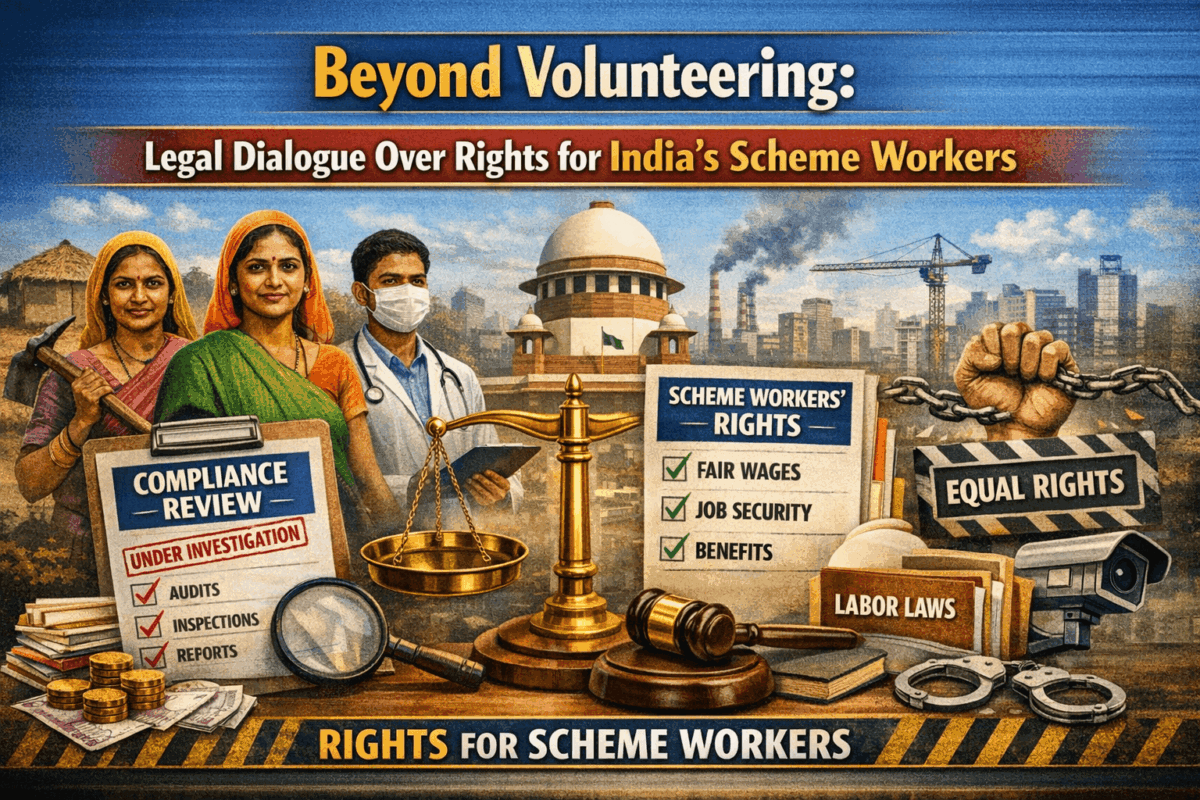
Millions of frontline workers in India’s welfare programs, including ASHA and Anganwadi staff, remain classified as “volunteers” rather than formal employees. As courts and legal experts revisit the principle that “perennial work deserves perennial posts,” the debate over extending minimum wage and social security protections to these workers is gaining momentum.
The “Volunteer” Status
Workers in government-led schemes such as the Integrated Child Development Services (ICDS) are often designated as “honorary workers.” They receive honorariums rather than salaries, and because they are not legally recognized as “employees” under the Code on Wages, 2019, statutory minimum wage provisions do not apply.
Legal Ambiguity
This classification places scheme workers in a unique legal position. They are neither self-employed nor formally employed, and many analyses suggest they are not fully covered as “unorganised workers” under the Code on Social Security, 2020. As a result, they are excluded from benefits such as provident fund, employee state insurance, and maternity protections.
Judicial Developments
A 2025 ruling (Dharam Singh v. State of UP) challenged the continued use of “honorary” status, holding that essential and permanent work cannot be perpetually treated as temporary. Earlier, in Maniben Maganbhai Bhariya (2022), courts recognized Anganwadi workers’ entitlement to gratuity. Legal observers note that consistent application of these rulings across states remains a compliance challenge.
The Care Ecosystem
India’s welfare infrastructure relies heavily on the labour of nearly five million women in ASHA and Anganwadi roles. Advocacy groups argue that their contribution forms the backbone of the care economy, and are calling for amendments to the Industrial Relations Code, 2020 to create a distinct “Scheme Worker” category with statutory protections.
Compliance Lens
Legal and professional experts highlight several areas for improvement:
- Defining Wages vs. Honorariums: Amending Section 2(k) of the Code on Wages to explicitly include scheme workers could resolve ambiguities.
- Statutory Integration: Introducing structured increments and promotion ladders would provide career progression and seniority-based benefits.
- Judicial Alignment: Ensuring uniform implementation of rulings that extend gratuity and other entitlements to scheme workers remains a key compliance hurdle.
Legal Context
- Code on Wages, 2019 – Section 2(k): Defines “wages,” currently excluding honorariums.
- Code on Social Security, 2020: Governs social security entitlements, with scheme workers presently outside its scope.
- Industrial Relations Code, 2020 – Section 4: Requires clear communication of employment terms, potentially relevant if scheme workers are reclassified.
- Judicial Precedents: Dharam Singh v. State of UP (2025) and Maniben Maganbhai Bhariya (2022) highlight evolving judicial recognition of scheme workers’ rights.
Outlook
The ongoing legal dialogue reflects India’s effort to balance welfare delivery with statutory protections. Observers note that the debate over wages, social security, and recognition of scheme workers is likely to shape future labour reforms, with courts and policymakers playing a central role in defining the path forward.
Disclaimer: This content is provided for informational purposes only and does not constitute legal, financial, or professional advice. Labour laws and government scheme regulations are subject to judicial interpretation and frequent legislative updates. Readers should consult with official government sources or qualified legal experts regarding specific statutory rights and compliance.