

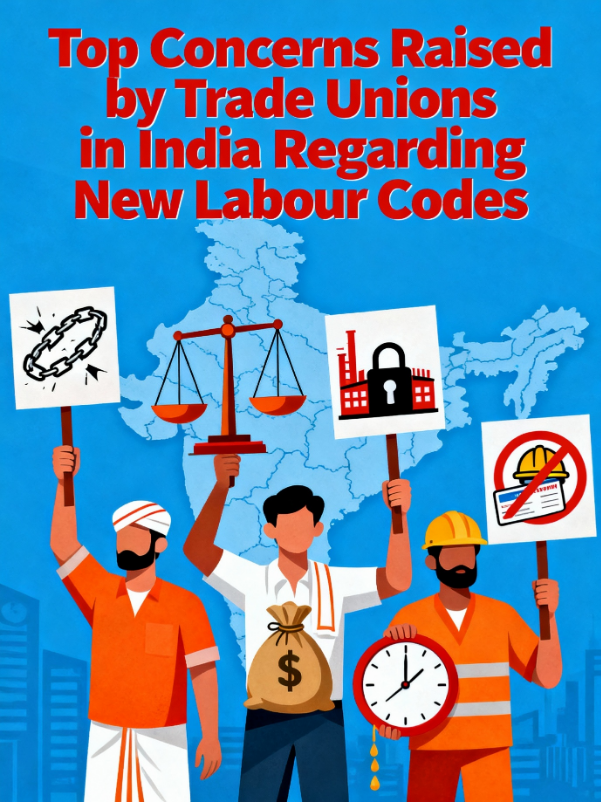
India’s new Labour Codes—consolidating 29 central laws into four streamlined frameworks—have sparked intense debate across the country. While the government promotes these reforms as a step toward simplification and modernization, trade unions argue they dilute worker protections and shift power disproportionately toward employers. From job security and the right to strike to collective bargaining and social security coverage, unions have raised critical concerns that demand attention. This blog explores the top objections voiced by trade unions and examines the broader implications for India’s workforce and industrial relations.
Major Trade Union Concerns
1. Weakening Job Security and Hire-and-Fire Norms
Increased Threshold for Layoffs: The Industrial Relations Code raises the employee threshold for establishments to seek prior government approval for layoffs, retrenchment, or closure from 100 workers to 300 workers. This change makes it easier for companies employing up to 300 people to terminate employment without government oversight, posing a severe threat to job security.
Promotion of Fixed-Term Employment (FTE): While FTE employees are now entitled to the same benefits as permanent workers, unions fear that employers will increasingly use short-term contracts to avoid offering permanent positions, thereby creating a precarious workforce, and circumventing long-term social security obligations.
2. Curtailment of the Right to Strike
Stricter Strike Conditions: The new codes introduce stringent conditions on the right to strike, making it significantly harder for workers to initiate a legal strike.
– Workers in any industry must give a 60-day notice before a strike.
– Strikes are prohibited during conciliation proceedings and for seven days thereafter, or during proceedings before a tribunal and for 60 days thereafter.
– This is viewed as an attempt to stifle workers’ voices and prevent quick action against unsafe or unfair conditions.
3. Dilution of Collective Bargaining Power
– Union Recognition and Negotiation: The Industrial Relations Code mandates that a negotiating union or council must represent at least 51% of the workers in an establishment to be the sole negotiating body. If no single union meets this threshold, a negotiating council is formed, with representation proportional to the union’s membership.
– Unions argue this limits the power and influence of smaller trade unions and reduces the overall representation for diverse worker groups.
– The requirement of a high membership threshold is seen as an attempt to limit the ease of union formation and reduce workers’ collective bargaining strength.
4. Flaws in Social Security and Minimum Wage Provisions
– Inadequate Universal Social Security: While the Code on Social Security aims to extend coverage, unions argue that it does not provide genuine “universal social security” and lacks clarity on benefit schemes for the unorganized, gig, and platform workers.
– Lack of Clear Minimum Wage Criteria: The Code on Wages introduces a National Floor Wage, but unions criticize the lack of transparent and scientific criteria for determining this floor wage, which they believe could be kept artificially low by the Central Government.
Summary of Trade Union Stance
The unions, often referring to the codes as “anti-worker, pro-employer” and a “deceptive fraud,” argue that the reforms prioritize ‘ease of doing business’ for corporate houses over the fundamental rights and welfare of workers. They claim that the laws were pushed through without sufficient tripartite consultation (Government, Employers, and Employees). The trade unions demand the withdrawal of the codes in their current form.
Concluding Perspective
While the trade unions have voiced strong reservations, it is equally important to recognize the potential benefits embedded within the labour codes. By consolidating and simplifying numerous overlapping laws, the codes aim to reduce ambiguity and bring greater transparency to labour regulations. This streamlining can help both employers and employees better understand their rights and obligations, thereby minimizing disputes. Moreover, provisions such as universal social security coverage, formalization of employment, and emphasis on safety and health standards have the capacity to extend protections to a wider segment of the workforce, including those in the unorganized sector. If implemented with sensitivity and strengthened through genuine dialogue among stakeholders, the labour codes could serve as a foundation for balancing economic growth with social justice ensuring that ease of doing business and welfare of workers move forward hand in hand.
Join the Conversation
Your thoughts matter. Share your perspective in the comments—healthy dialogue helps us all understand labour law better.
Need Guidance?
Feel free to book a consultation. Expert advice can make compliance smoother and more effective.
Spread the Knowledge
If you found this article useful, don’t keep it to yourself—share it with colleagues, friends, or on social media. Together, we can build greater awareness of labour rights and responsibilities.
Disclaimer – This blog post is a general guide. It should not be considered legal advice. Consult a legal professional for more details.