 Total Visitors
  Online Users
  Today
Today  Yesterday

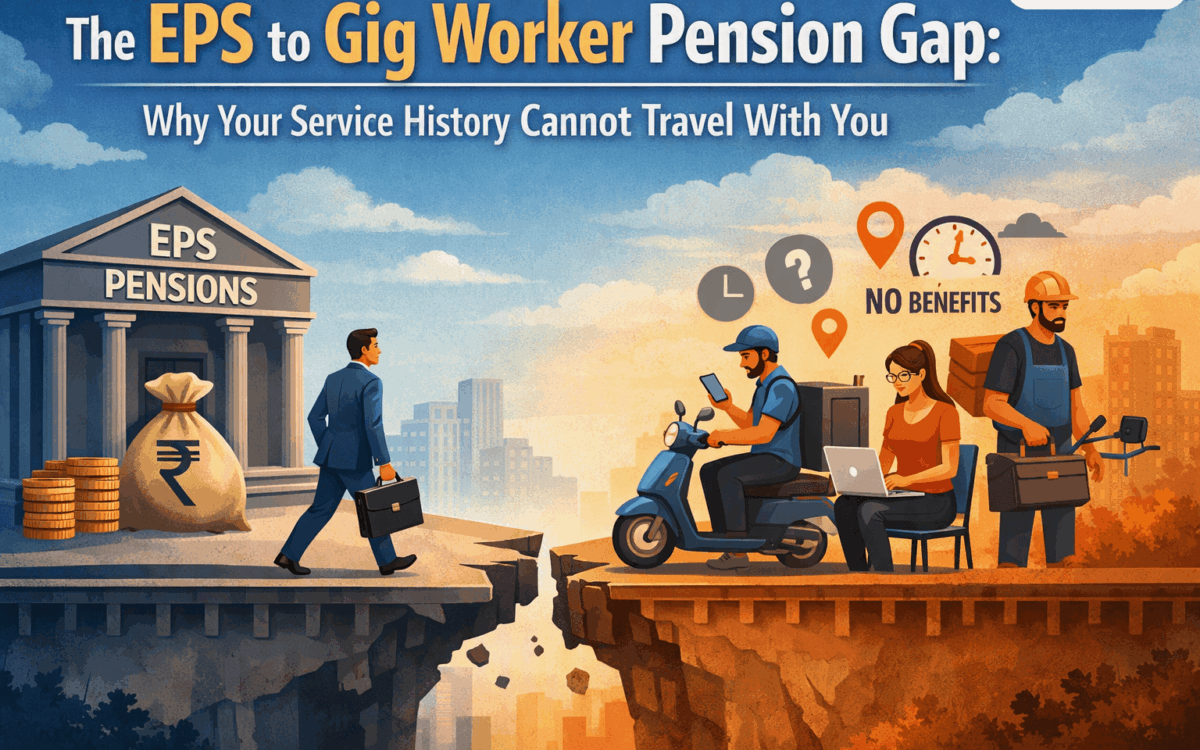
You have worked for eight years in a traditional corporate job. You have contributed to the Employees’ Pension Scheme (EPS) every month. Your employer has matched it. You are just two years away from crossing the ten-year threshold that guarantees you a monthly pension for life.
Then you decide to leave. You join a platform. You become a Zomato delivery partner, an Uber driver, a Swiggy executive. You are now part of India’s gig economy.
What happens to those eight years of pensionable service?
The short answer: they sit in a silo. The longer answer: as of August 2026, there is no statutory mechanism to transfer your EPS service history into the new social security framework for gig workers. This is not a theoretical concern. It is a live regulatory gap that affects millions of Indians as they move between the formal organised sector and the rapidly expanding platform economy.
What the New Labour Codes Actually Say About Gig Workers
The Code on Social Security, 2020, which was notified on 21 November 2025 and operationalised in phases through 2026, does something unprecedented in Indian legislative history. For the first time, it formally recognises gig workers and platform workers as distinct categories of workers. The definitions are codified in Sections 2(35) through 2(37) of the Code.
A gig worker means a person who performs work or participates in a work arrangement and earns from such activities outside of a traditional employer-employee relationship . A platform worker is a person engaged in platform work, which means a work arrangement outside of a traditional employer-employee relationship in which organisations or individuals use an online platform to access other organisations or individuals to solve specific problems or to provide specific services .
This is a significant achievement. Earlier, gig workers fell through the cracks of every major social security statute. The Payment of Wages Act, the Minimum Wages Act, the EPF Act, and the ESI Act all operated on a binary employer-employee relationship. Gig workers were neither employees nor independent contractors with enforceable rights. They simply did not exist in the legal framework.
The Code changes that by mandating that aggregators contribute between 1% and 2% of their annual turnover to a dedicated Social Security Fund, capped at 5% of the total payments made to gig and platform workers . This fund finances life and disability cover, health and maternity benefits, accident insurance, and pension benefits.
Each worker receives a unique Aadhaar-linked ID generated through registration on the e-Shram portal, which allows their social security benefits to be portable across platforms . The government has been actively pushing aggregators like Swiggy, Zomato, Uber, Ola, Rapido, Blinkit, and Zepto to register their gig workforce on the e-Shram portal, with a deadline of 21 June 2026 for integration . The portal already has the database of aggregators, and the government can understand, on a real-time basis, the benefits which the worker can or has availed .
All of this is real. All of this is operational. But none of it addresses what happens to the EPS service history you built before you became a gig worker.
EPS 2026: The New Pension Scheme That Changes Nothing for This Problem
On 29 June 2026, the Ministry of Labour and Employment notified the Employees’ Pension Scheme (EPS) 2026, replacing the three-decade-old EPS 1995 . Existing EPS members were automatically migrated to the new scheme. Their rights and benefits remain protected .
The pension formula remains unchanged: (Pensionable Salary x Pensionable Service) / 70 . The pensionable salary cap stays at ₹15,000 for most employees. The minimum monthly pension remains ₹1,000 . The employer contribution remains 8.33% of pensionable wages .
The ten-year vesting condition remains intact. You need a minimum of ten years of pensionable service to qualify for a monthly pension . For a salary of ₹15,000, ten years of service gives you approximately ₹2,143 per month in pension. Twenty years gives you ₹4,286. Thirty-five years gives you ₹7,500.
EPS 2026 introduced several administrative improvements. Pension claims must be settled within twenty days. Failure to do so attracts 12% annual interest, payable from the PF Commissioner’s salary . Most procedures are now available online. Digital compliance and online processing are emphasised .
But none of these changes create a bridge between the EPS framework and the new Social Security Fund for gig workers.
The Regulatory Gap: Two Systems, No Bridge
The problem is structural. The EPS operates under the EPFO framework, administered by the Central Board of Trustees. It is designed for establishments with an employer-employee relationship. The Social Security Fund for gig workers is a separate statutory vehicle, administered under the Code on Social Security, 2020, with contributions from aggregators and governments .
The Code recognises gig workers as a distinct category precisely because they operate outside the traditional employer-employee relationship. This is the same reason they were excluded from EPF and ESI coverage in the first place .
Consider the arithmetic. You have eight years of pensionable service in the EPS. You need ten years to qualify for a monthly pension. You move to platform work. Your eight years sit in the EPFO system. The gig worker social security framework does not recognise those eight years. It has its own contribution mechanism, its own eligibility criteria, its own pension calculation.
There is no provision in the Code, no notification from the Ministry, no operational guideline from EPFO, that allows you to transfer your EPS service history into the gig worker fund. There is no mechanism to count your future gig work towards the ten-year EPS vesting threshold. There is no mechanism to merge your prior EPS service into the gig worker pension scheme for the purpose of calculating a combined pension.
The portability promised by the e-Shram portal refers to portability within the gig worker framework. You can move from one platform to another and your benefits follow you. But it does not refer to portability between the organised sector EPS and the gig worker framework.
This is the gap. Your EPS service history remains preserved but dormant; it cannot be merged with gig worker benefits under current law.
The PF Withdrawal Trap: Even Worse Than You Think
There is another dimension to this problem. Many employees, when they leave a job, withdraw their entire PF balance. They assume that this settles everything. It does not.
The EPS service history and the EPF balance are two separate components of the same account. When you withdraw your PF balance, you are only withdrawing your own and your employer’s provident fund contributions. The EPS service history remains attached to your old member ID. It does not automatically transfer when you join a new employer. It does not transfer when you withdraw your PF.
If you do not file Form 13 to transfer your EPS service history, those years of service are not counted towards your total pensionable service. You could have ten years of service spread across three employers, but if you never transferred the EPS history, you might show only three years of service in your current employer’s record. This directly affects your pension eligibility and the final pension amount.
The same logic applies when you move to gig work. Your EPS service history remains with the EPFO. The gig worker framework has no mechanism to import it. Your eight years remain frozen. They cannot be combined with anything you do in the gig economy.
Under EPS 2026, members with less than ten years of eligible service continue to have two options: receive a withdrawal benefit, or obtain a Scheme Certificate so that the service can be added if they join another EPF-covered establishment later . But neither option allows the service to be transferred to the gig worker social security fund.
What the Government Is Doing, and What It Is Not Doing
The government is actively operationalising the social security framework for gig workers. The National Social Security Board is being set up . Schemes for accident and maternity benefits are under development . Fund managers are being engaged to ensure the schemes are operationalised . The National Social Security Board will look at unorganised workers and recommend suitable social welfare schemes for platform workers .
The e-Shram portal is being strengthened as a digital backbone. The government has described it as having the potential to change how benefits are delivered to workers, with the portability of benefits being a key feature .
But all of this is within the gig worker framework. There is no indication, in any notification, press release, or official statement, that the government is working on a mechanism to bridge the EPS and gig worker social security frameworks. The Code on Social Security, 2020, recognises gig workers as a separate category with a separate funding mechanism. The two systems are structurally distinct.
Whether the government will eventually introduce a mechanism for inter-system portability remains an open question. As of August 2026, no such framework has been operationalised.
What This Means for You
If you have EPS service history from traditional employment and you are considering moving to gig or platform work, you need to understand the trade-off.
Your EPS service history is not lost. It remains in the EPFO system. You can still claim a pension if you eventually return to formal employment and cross the ten-year threshold. But if you remain in the gig economy, your EPS service history cannot be combined with any benefits you accumulate under the new gig worker framework.
You might think of it as a choice between two parallel tracks. Track A is the EPFO/EPS track for formal employment. Track B is the new gig worker social security track. You can accumulate benefits on both tracks, but you cannot merge them. The ten-year vesting condition on Track A requires ten years of service within that track. Service on Track B does not count.
This is not a criticism of the government’s efforts. Recognising gig workers and creating a dedicated social security fund is a significant reform. It is a step forward. But the gap between the old and the new systems is real, and it affects real people.
If you are a professional with eight years of EPS service, you are not just two years away from a pension. You are two years away from a pension within the formal sector system. Moving to gig work resets that clock. Your eight years remain, but they cannot be combined with anything you do on the other side.
A Disclaimer, Not a Conclusion
This analysis is based on the Code on Social Security, 2020, the EPS 2026 notification dated 29 June 2026, and the operational framework for gig workers as articulated by the Ministry of Labour and Employment. It is statutory commentary and operational analysis, not legal advice.
The regulatory landscape is dynamic. The government may, in the future, introduce provisions for inter-system portability. Aggregators and workers may develop alternative mechanisms for pension continuity. But as of August 2026, the gap exists.
If you are considering a move from formal employment to gig work, consult a qualified legal professional who can advise you based on your specific circumstances. Your pension is not a theoretical issue. It is the difference between financial security in retirement and its absence.
Disclaimer: The information and analysis provided in this article constitute statutory observation and operational analysis based on notifications published by the Ministry of Labour and Employment, EPFO, ESIC, and other relevant government authorities up to August 2026. This content is for informational purposes only and does not constitute formal legal advice or create an attorney-client relationship. The legal landscape is dynamic, and specific facts and circumstances can materially alter outcomes. Readers are strongly advised to consult a qualified legal professional to obtain advice tailored to their specific situation before making any decisions or taking any action.