

Introduction
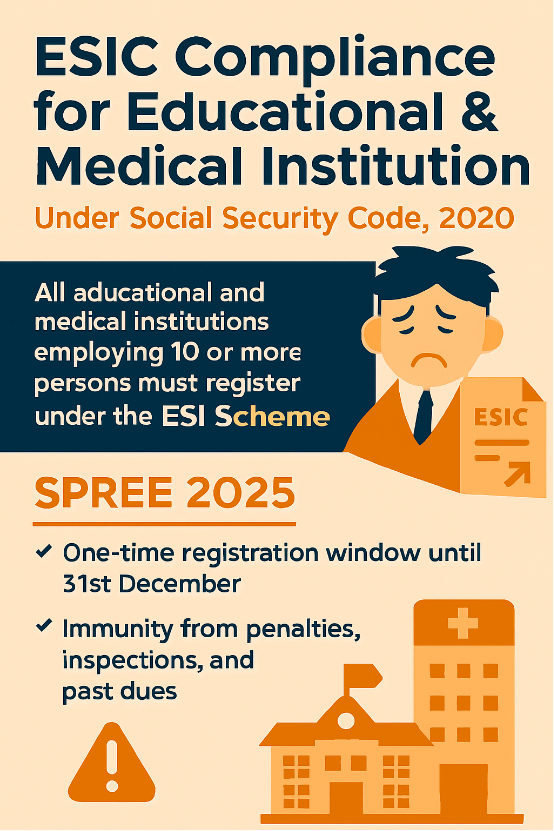
With the nationwide implementation of the four Labour Codes from 21st November 2025, the Employees’ State Insurance Corporation (ESIC) has issued a compliance directive specifically targeting educational and medical institutions. Under Section 2(29) of the Code on Social Security, 2020, these institutions now fall within the definition of “establishment” and are mandatorily required to register under the ESI Scheme if they employ 10 or more persons. This blog explains the statutory obligations, registration process, and consequences of non-compliance, based on the official ESIC circular dated 03-12-2025.
ESIC Notification: Applicability of Labour Codes from 21st November 2025
The ESIC circular confirms that all four Labour Codes viz. Code on Wages, Industrial Relations Code, Code on Social Security, and OSH Code have come into force nationwide. Chapter IV of the Social Security Code mandates ESI coverage for establishments employing 10 or more persons, including educational and medical institutions.
Section 2(29): Educational and Medical Institutions as “Establishments”
As per Section 2(29)(a) of the Code, educational and medical institutions are explicitly recognized as establishments. This classification brings them under the purview of ESIC, making ESI registration and contribution mandatory.
Mandatory ESI Registration for Institutions Employing 10 or More Persons
Institutions that have not yet registered under the ESI Scheme must do so immediately. The registration must be completed online via the Shram Suvidha Portal or the ESIC Employer Portal. This applies to both direct employees and those engaged through contractors.
Wage Definition Under Section 2(88): What Employers Must Know
Employers must calculate ESI contributions based on the redefined wage structure:
Included:
- Basic Pay
- Dearness Allowance (DA)
- Retaining Allowance (RA)
Excluded (subject to 50% cap):
- HRA
- Conveyance allowance
- Overtime
- Commission
- Bonus
- Employer PF contribution
- Gratuity
- Value of housing, water, light, medical facilities
- Reimbursements
If excluded components exceed 50% of total remuneration, the excess must be added back to wages for ESI calculation.
SPREE 2025: One-Time Registration Window Until 31st December
SPREE 2025 offers a one-time compliance opportunity for employers to register without facing penalties, inspections, or retrospective dues. The window is open from 1st July to 31st December 2025.
Benefits of SPREE 2025:
- Immunity from past dues and penalties
- Hassle-free digital registration
- Immediate access to ESI benefits for employees
ESI Coverage for Contractual and Outsourced Employees
The ESIC circular clarifies that executive authorities of institutions are responsible for ESI contributions for both direct and contractor-supplied employees, provided they are eligible under the scheme.
Online Registration Process via Shram Suvidha and ESIC Portals
Employers must:
- Register the establishment online
- Enroll eligible employees with Aadhaar authentication
- Generate Insurance Numbers
- Issue E-Pehchan Cards
Consequences of Non-Compliance Under the Social Security Code
Failure to comply may result in:
- Recovery of dues as arrears of land revenue
- Penal interest and damages
- Criminal prosecution
- Denial of statutory benefits to employees
Action Checklist for Educational and Medical Institutions
- Confirm ESI applicability
- Register establishment and employees
- Recalculate wages using Section 2(88)
- Deposit contributions on time
- Maintain statutory records
- Ensure contractor compliance
Conclusion
The ESIC’s directive marks a critical shift in India’s social security enforcement. Educational and medical institutions must act swiftly to register under the ESI Scheme, restructure payrolls, and ensure full compliance with Section 2(88) of the Social Security Code. SPREE 2025 offers a rare opportunity to regularize without penalties but the window closes on 31st December 2025. Proactive compliance is not just a legal obligation it is a strategic safeguard against future litigation and regulatory exposure.
Join the Conversation
Your thoughts matter. Share your perspective in the comments—healthy dialogue helps us all understand labour law better.
Need Guidance?
Feel free to book a consultation. Expert advice can make compliance smoother and more effective.
Spread the Knowledge
If you found this article useful, don’t keep it to yourself—share it with colleagues, friends, or on social media. Together, we can build greater awareness of labour rights and responsibilities.
Disclaimer – This blog post is a general guide. It should not be considered legal advice. Consult a legal professional for more details.