

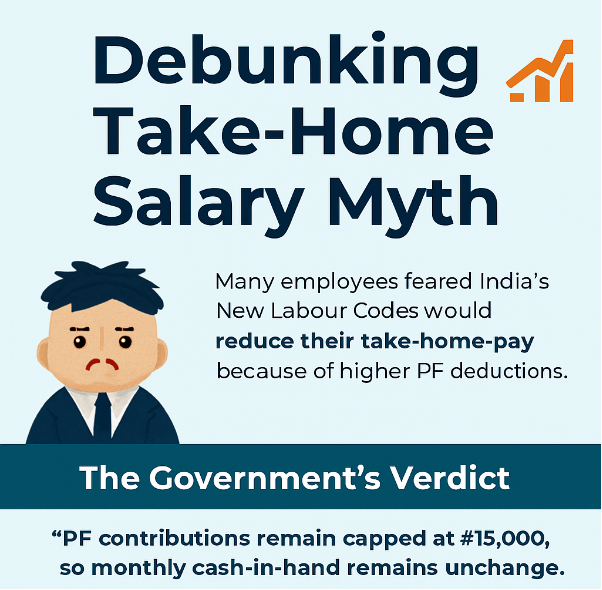
The rollout of India’s New Labour Codes has sparked widespread debate, with employees fearing a sharp drop in their take‑home salary due to higher Provident Fund (PF) deductions. Much of this panic stems from the 50% Wages Rule, which restructures how allowances and basic pay are defined. However, recent clarifications from the Ministry of Labour confirm that PF contributions remain capped at ₹15,000, meaning most employees will see no reduction in monthly cash‑in‑hand. In this article, we break down the law, the math, and the myths to help you understand exactly how the Labour Codes impact your salary in 2025.
What Triggered the Panic? Understanding the 50% Wages Rule
Under the New Labour Codes, “Wages” must constitute at least 50% of Total Remuneration.
This means:
- Basic Pay
- Dearness Allowance
- Retaining Allowance
together must form half or more of your salary.
If allowances exceed 50%, the excess must be added back to “Wages.”
This led many to assume:
Higher Basic → Higher PF → Lower Take-Home
But this assumption ignores a critical legal safeguard.
The Government’s Official Clarification: No Automatic Salary Reduction
According to the Ministry of Labour:
Take-home salary will not reduce as long as PF is calculated on the statutory wage ceiling of ₹15,000.
This clarification was issued to calm widespread concerns after the Codes were notified.
The Economic Times also reported that the Ministry explicitly stated:
PF contributions beyond ₹15,000 are voluntary, not mandatory.
This single point changes everything.
Let’s Look at the Numbers: The Official Illustration
Using the Ministry’s example (also reported by Economic Times):
Before the Codes
- Total Salary: ₹60,000
- Basic Pay: ₹20,000
- Allowances: ₹40,000
- PF Deduction (12% of ₹15,000): ₹1,800
- Take-Home: ₹56,400
After the Codes (50% Rule Applied)
- Total Salary: ₹60,000
- Basic Pay (Adjusted): ₹30,000
- Allowances: ₹30,000
- PF Deduction: Still ₹1,800
- Take-Home: Still ₹56,400
No change in take-home pay
No increase in PF deduction
Only the structure changes, not the cash in hand
Why? Because of the statutory PF wage ceiling.
The ₹15,000 PF Wage Ceiling — The Real Reason Your Salary Stays the Same
Under the EPF Act, employers are required to contribute:
- 12% of ₹15,000 = ₹1,800
This ceiling remains unchanged under the New Labour Codes.
So even if your “Wages” increase due to restructuring:
- PF does NOT automatically increase
- Take-home does NOT automatically decrease
- Employers are NOT forced to contribute more
This is exactly what the Ministry reiterated in its public clarification.
Why Did People Think Take-Home Would Fall?
Because many assumed:
- PF would be calculated on the entire revised Basic, not the ceiling
- Employers would be forced to increase contributions
- Salary structures would shrink cash-in-hand
But the law is clear:
PF above ₹15,000 is voluntary
Employers can choose to cap PF at ₹15,000
The Labour Codes do not mandate higher PF contributions
The panic came from misinterpretation, not from the Codes themselves.
Two Real-World Scenarios You Must Understand
1. PF on Statutory Wage Ceiling (Most Companies)
If your employer caps PF at ₹15,000:
- PF stays at ₹1,800
- Take-home stays the same
- Only the salary structure changes
No impact on your monthly income
This is the scenario the Ministry referred to in its clarification.
2. PF on Actual Basic (Used by Some Corporates)
Some companies voluntarily calculate PF on the full basic salary, not the ceiling.
In such cases:
- Higher Basic → Higher PF
- Take-home may reduce
- Retirement savings increase
This is a company policy, not a Labour Code requirement.
What Should Employees Do Now?
Before assuming your salary is being cut, check:
Does your company cap PF at ₹15,000?
If yes → No change in take-home
Does your company deduct PF on actual basic?
If yes → Expect a dip, but higher retirement savings
Has HR shared the revised salary structure?
If not → Request the updated CTC breakup
Key Takeaways
- New Labour Codes do not reduce take-home salary automatically
- PF remains unchanged if calculated on the statutory ceiling
- The 50% Wages Rule affects structure, not cash-in-hand
- Salary reduction happens only if PF is calculated on actual basic
- Government clarification confirms no mandatory increase in PF
Final Verdict: Your Take-Home Salary Is Safe — In Most Cases
The New Labour Codes aim to bring uniformity, transparency, and long-term social security, not reduce salaries.
The fear of reduced take-home pay was based on misinterpretation, not legal reality.
No automatic salary cut
PF remains capped unless employer chooses otherwise
Salary restructuring ≠ salary reduction
Before worrying, simply check your company’s PF policy — that is where the real answer lies.
Join the Conversation
Your thoughts matter. Share your perspective in the comments—healthy dialogue helps us all understand labour law better.
Need Guidance?
Feel free to book a consultation. Expert advice can make compliance smoother and more effective.
Spread the Knowledge
If you found this article useful, don’t keep it to yourself—share it with colleagues, friends, or on social media. Together, we can build greater awareness of labour rights and responsibilities.
Disclaimer – This blog post is a general guide. It should not be considered legal advice. Consult a legal professional for more details.