

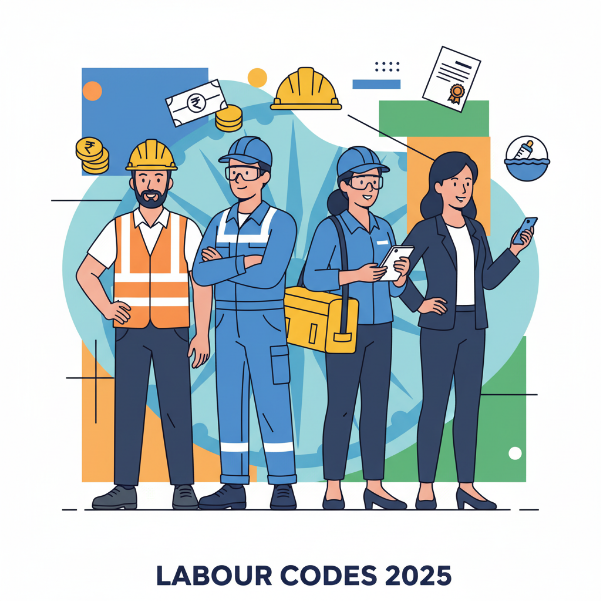
India’s labour laws have entered a new era with the introduction of four consolidated Labour Codes, replacing 29 fragmented regulations. This landmark reform, initiated in 2020, aims to protect over 50 crore workers—especially those in the unorganized sector—while simplifying compliance for businesses. Covering wages, social security, occupational safety, and industrial relations, these codes promise fair compensation, improved working conditions, and tech-enabled governance. Whether you are an employer navigating new mandates or a worker seeking clarity on entitlements, this blog offers a comprehensive breakdown of what the Labour Codes mean for India’s workforce..
The Wage Code 2019: Ensuring Fair Compensation
The Wage Code 2019 is a game-changer, guaranteeing a minimum wage for all workers. This code merges four old laws into one, ensuring timely payments with a ceiling of up to Rs 24,000, equal pay for men and women, and a “floor wage” to bridge regional disparities. For the unorganized sector, which comprises 40 crore workers, this is a monumental shift after 73 years. Employers now face web-based random checks instead of the old inspector raj, and wages are directly deposited into bank accounts or paid via cheque. This not only simplifies processes for businesses but also provides workers with much-needed financial security.
The Social Security Code 2020: A Comprehensive Safety Net
The Social Security Code 2020 is a robust framework that addresses pensions, insurance, gratuity, and maternity benefits. It expands the Employees’ State Insurance Corporation (ESIC) from 566 to all 740 districts, covering gig workers, plantations, and hazardous jobs. The Employees’ Provident Fund Organisation (EPFO) now includes unorganized and self-employed workers, with a dedicated fund for them. Fixed-term employees receive the same benefits as permanent staff, eliminating service minimums for gratuity. The Aadhaar-linked Universal Account Number (UAN) ensures portability across the nation, and employers with 20 or more employees are required to post job openings online. The government also contributes to the pensions of the needy, turning the dream of a Rs 3,000 monthly pension into a reality through schemes like PM Shram Yogi Mandhan.
The Occupational Safety and Health Code 2020: Prioritizing Worker Well-being
The Occupational Safety and Health (OSH) Code 2020 focuses on health, safety, and decent working conditions. It consolidates 13 laws covering factories, mines, migrants, and more. Interstate migrants can self-register on a national portal for identity and access to various schemes, including annual travel allowances and the One Nation One Ration card. Appointment letters are now mandatory, and workers are entitled to free yearly health checks. Women can work night shifts with appropriate safety measures in place. Leaves have been improved, with one day off for every 20 days worked after 180 days of service. Construction cess funds follow workers across states, and helplines in every state ensure swift resolution of grievances.
The Industrial Relations Code 2020: Streamlining Dispute Resolution The Industrial Relations Code 2020 aims to maintain peace in the workplace by combining three laws. Unions with 51% of votes can negotiate independently, or councils can be formed otherwise. Industrial tribunals strive for one-year resolutions with two-member benches. Retrenched workers receive 15 days’ wages for re-skilling, directly deposited into their bank accounts. Job-loss aid is provided through schemes like Atal Beemit Vyakti Kalyan. While strikes remain untouched, states have the flexibility to tailor the code to their needs, given labour’s concurrent status. The code promotes a win-win approach, moving away from the traditional “industry vs labour” mindset.
Why These Codes Matter
The codification of these laws means tech-driven inspections, fewer forms, and common terminology, significantly easing the burden of compliance for businesses. Women workers benefit from crèches in larger firms, the right to work night shifts, and overall empowerment. Migrants thrive with improved databases and portability of benefits. While implementation is crucial, with states notifying the rules, this framework signals progress: more jobs, better productivity, and stronger employer-worker relationships. As a labour law consultant advising firms in Maharashtra, I have witnessed the relief and focus on growth that these changes bring.
In conclusion, India’s new Labour Codes represent a significant step forward in ensuring the rights and well-being of workers while simplifying regulations for businesses. These codes are not just legal frameworks but a testament to the country’s commitment to “Satyamev Jayate” in action. Let us embrace these changes and work towards a more equitable and productive future for all.
Join the Conversation
Your thoughts matter. Share your perspective in the comments—healthy dialogue helps us all understand labour law better.
Need Guidance?
Feel free to book a consultation. Expert advice can make compliance smoother and more effective.
Spread the Knowledge
If you found this article useful, don’t keep it to yourself—share it with colleagues, friends, or on social media. Together, we can build greater awareness of labour rights and responsibilities.
Disclaimer – This blog post is a general guide. It should not be considered legal advice. Consult a legal professional for more details.