

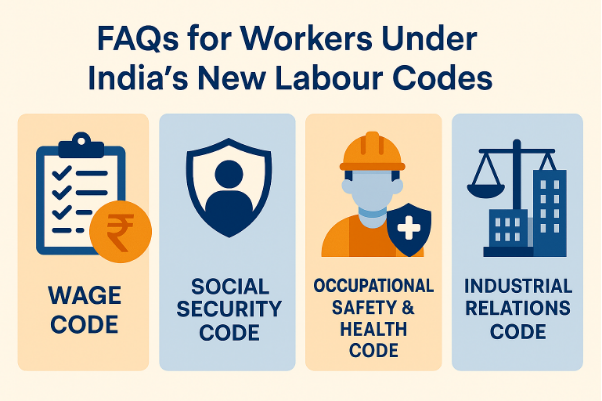
India’s new Labour Codes have redefined workplace rights and protections for over 50 crore workers. From minimum wages and social security to safety standards and dispute resolution, these reforms aim to simplify compliance and extend benefits—especially to those in the unorganized sector. But for many workers, the changes raise questions: What am I entitled to? How do I access benefits? This blog answers the most frequently asked questions under each of the four Labour Codes, helping workers understand their rights and navigate the new framework with confidence.
Wage Code 2019: Ensuring Fair Compensation
Q1. How will the Wage Code affect my salary?
The Wage Code mandates that at least 50% of your salary must be counted as “basic pay.” This may reduce allowances but ensures fairer overtime and PF calculations.
Q2. Am I entitled to a minimum wage?
Yes. Every worker, including those in the unorganized sector, is entitled to a minimum wage set by the government.
Q3. Will my wages be paid on time?
The code requires timely payment of wages, either directly into your bank account or via cheque.
Q4. Does the Wage Code ensure equal pay for men and women?
Yes. Employers must provide equal pay for equal work, regardless of gender.
Social Security Code 2020: Expanding the Safety Net
Q1. Am I covered under ESIC or EPFO if I am a gig or unorganized worker?
Yes. The Social Security Code extends ESIC and EPFO coverage to gig, platform, and unorganized workers.
Q2. Do fixed-term employees get gratuity?
Yes. Fixed-term employees are entitled to gratuity without the earlier minimum service requirement.
Q3. How does the Universal Account Number (UAN) help me?
Your Aadhaar-linked UAN ensures portability of PF and social security benefits across jobs and states.
Q4. Will I receive pension benefits?
Eligible workers can access government-supported pension schemes such as PM Shram Yogi Mandhan, which provides a monthly pension.
Occupational Safety & Health (OSH) Code 2020: Prioritizing Well-being
Q1. What safety rights do I have at work?
Employers must provide safe working conditions, including protective equipment and annual health check-ups.
Q2. Can women work night shifts under the new code?
Yes, but employers must ensure adequate safety measures such as secure transport and workplace security.
Q3. What leave am I entitled to?
Workers earn one day of leave for every 20 days worked after 180 days of service.
Q4. How are migrant workers protected?
Migrant workers can self-register on a national portal to access schemes, travel allowances, and ration portability.
Industrial Relations Code 2020: Streamlining Dispute Resolution
Q1. Can my employer lay me off without government approval?
Employers with fewer than 300 workers can retrench without prior government approval, which unions argue reduces job security.
Q2. What happens if I lose my job?
Retrenched workers are entitled to 15 days’ wages for re-skilling, deposited directly into their bank accounts.
Q3. How does the code affect my right to strike?
Workers must give 60 days’ notice before striking, and strikes are restricted during conciliation or tribunal proceedings.
Q4. How is union representation determined?
A union must represent at least 51% of workers to be recognized as the sole negotiating body. Otherwise, a council is formed with proportional representation.
Conclusion
These FAQs highlight how the four Labour Codes reshape worker rights—from wages and social security to safety and industrial relations. While the reforms aim to simplify compliance and extend protections, workers should stay informed, track their entitlements, and engage with employers or unions to ensure their rights are upheld.
Join the Conversation
Your thoughts matter. Share your perspective in the comments—healthy dialogue helps us all understand labour law better.
Need Guidance?
Feel free to book a consultation. Expert advice can make compliance smoother and more effective.
Spread the Knowledge
If you found this article useful, don’t keep it to yourself—share it with colleagues, friends, or on social media. Together, we can build greater awareness of labour rights and responsibilities.
Disclaimer – This blog post is a general guide. It should not be considered legal advice. Consult a legal professional for more details.