 Total Visitors
  Online Users
  Today
Today  Yesterday

Statutory Genesis & Current Legal Posture
The Employees’ State Insurance Scheme now operates under Chapter IV of the Code on Social Security, 2020, which came into nationwide effect on November 21, 2025. The Code consolidated nine central social security enactments into a unified legislative framework. The ESI Act, 1948 stands repealed, but its rules and regulations continue in force through savings provisions until November 20, 2026, to the extent they are not inconsistent with the Code, as provided under Section 164 of the Code on Social Security, 2020.
The contribution obligations under the Code are established by Section 29, which mandates that the contribution payable in respect of an employee shall comprise the employer’s contribution and the employee’s contribution, both payable to the Corporation at prescribed rates. The contribution rates stand at 3.25% of gross wages for the employer and 0.75% for the employee, with the wage ceiling at ₹21,000 per month (₹25,000 for persons with disability). The contribution periods run from April to September and October to March, with corresponding benefit periods from January to June and July to December.
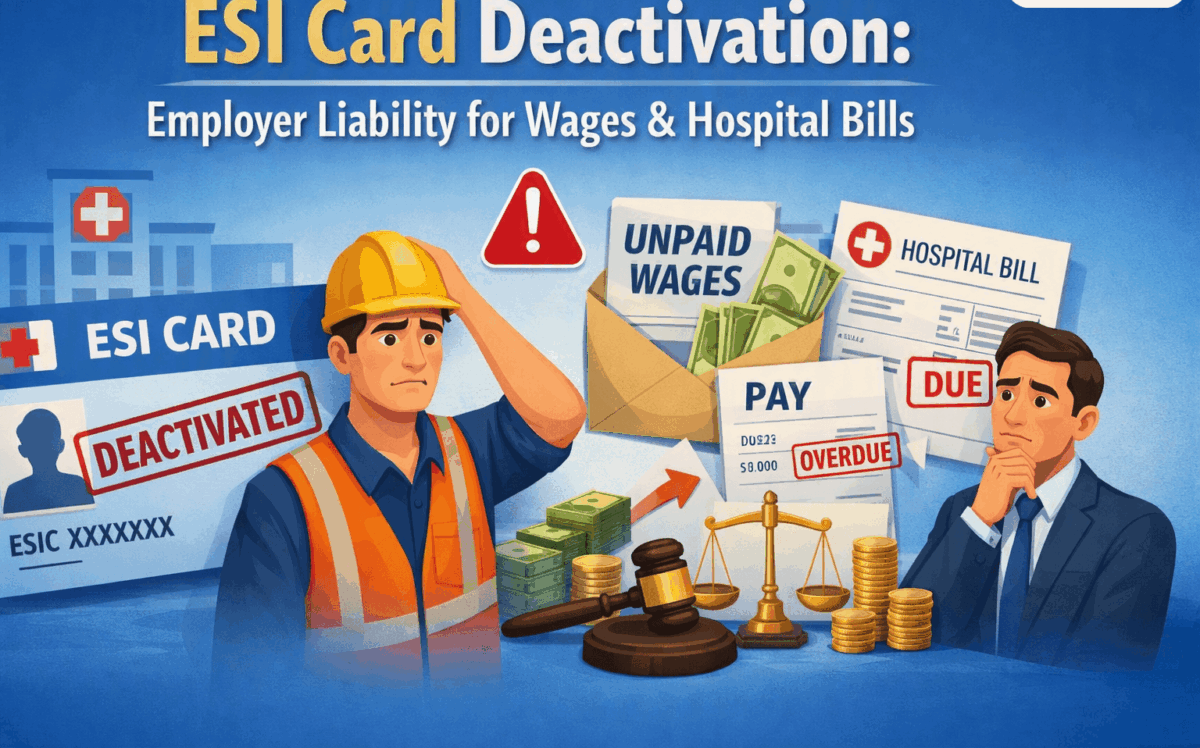
The question of employer liability for wages when an employee is hospitalized and the ESI card shows a deactivated status due to delayed company contributions requires examination of three distinct legal frameworks: the ESI benefit structure, the employer’s statutory obligations under the Code, and the general law on wages during illness. The core legal principle is that ESI medical benefits and wage entitlement are separate legal constructs. The ESI scheme provides medical benefit from the date of joining insurable employment, and this entitlement continues regardless of the employer’s deposit status. However, the deactivation of an ESI card in the digital system creates an operational friction that demands careful navigation.
Legacy Framework vs. Current ESIC Framework
| Parameter | Legacy Framework (ESI Act, 1948) | New Framework (Code on Social Security, 2020) | Practical Operational Impact |
| Primary Obligation | Principal employer must pay both employer and employee contributions, with power to deduct employee share from wages | Section 29 of the Code mirrors the obligation | The employer’s liability is primary and absolute |
| Medical Benefit Entitlement | Available from date of joining insurable employment; continues regardless of contribution deposit status | Code preserves the medical benefit structure | Decoupling of benefit from payment means employee retains entitlement even on employer default |
| ESIC Card Deactivation | Physical contribution cards; deactivation was not an automated process | Digital e-Pehchan Card tied to employer contribution status; automated deactivation on prolonged default | System-generated deactivation creates a practical barrier despite legal entitlement continuing |
| Recovery from Defaulting Employer | Section 68 permits recovery of capitalized value of benefits paid | Recovery provisions under the Code mirror earlier framework | ESIC pays the hospital bills, then recovers from the defaulting employer |
| Wages During Hospitalization | Sickness benefit at 70% of wages for up to 91 days, not full wages | Same structure under the Code | Employer is not liable for full wages; ESI sickness benefit is the primary cover |
| Penal Consequences for Default | Interest at 12% p.a.; damages 5-25%; prosecution with imprisonment up to 3 years | Code provides for similar penalties | Directors and managers face personal prosecution risk |
| Prosecution Sanction | Section 86 required prior sanction of Insurance Commissioner for prosecution | Similar sanction mechanism under the Code | No prosecution can be instituted without proper sanction |
Operational Implementation Framework for HR & Legal Teams
The Core Legal Principle: Medical Entitlement and Wage Entitlement Are Distinct
The ESI scheme provides a comprehensive social security net covering medical benefit, sickness benefit at 70% of wages, maternity benefit, disablement benefit, dependants’ benefit, and funeral expenses. The employer’s liability to pay wages during hospitalization is governed by the Sickness Benefit provisions, not by the employer’s general wage obligation under the Code on Wages, 2019.
When an employee is hospitalized, the following structure applies:
ESI Sickness Benefit: The insured person is entitled to sickness benefit at 70% of average daily wages for a certified sickness period of up to 91 days per year. This benefit is payable by the ESI Corporation, not by the employer. The condition for entitlement is the payment of contributions for at least 78 days in the corresponding contribution period and completion of nine months in insurable employment.
Employer’s Wage Obligation: The employer is not liable to pay full wages during hospitalization unless the company’s employment policy or the employment contract provides for paid sick leave. The ESI scheme is designed to replace wages during illness, not supplement them.
The Deactivation Problem: In the digital system, the employee’s e-Pehchan Card may show a deactivated or dormant status if the employer has not deposited contributions for an extended period. This creates a practical barrier at the hospital. The hospital’s system may deny treatment because the card status does not show active coverage.
Digital deactivation is a system flag, not a legal termination of entitlement. ESIC hospitals must provide treatment once insurable status is confirmed. The card deactivation does not affect the employee’s statutory entitlement to benefits under the Code.
Step-by-Step Corporate Workflow for Default Scenario [FREE]
Step 1: Employee Hospitalization and Card Rejection: The employee presents the e-Pehchan Card at an ESIC hospital. The hospital system shows deactivated status due to delayed employer contributions. The hospital either denies admission or requires payment upfront.
Step 2: Employer’s Immediate Obligation: The employer’s immediate obligation is to ensure that the employee receives medical treatment. The employer may need to:
- Make alternative payment arrangements with the hospital
- Escalate with the local ESIC office to get the card reactivated or to secure a certificate confirming continued eligibility
- Reimburse the employee for out-of-pocket expenses if treatment is sought in a non-ESIC facility.
Step 3: Legal Position on Medical Entitlement: The employer’s legal position is clear. The ESI Corporation must provide benefits to insured persons, even if the employer has defaulted on contributions. The Corporation can subsequently recover the capitalized value of the benefit paid from the defaulting employer. The Gujarat High Court has confirmed this position, holding that ESIC must pay benefits even where employer default exists.
Step 4: Sickness Benefit Filing: The employee is entitled to sickness benefit at 70% of wages for up to 91 days per year. The employer must facilitate the filing of the sickness benefit claim by:
- Issuing the required certificate of sickness
- Certifying the employee’s wage details
- Ensuring the claim is submitted to the ESI Corporation.
Step 5: Employer’s Consequence Analysis: For a three-month default, the employer faces:
- Interest at 12% per annum on delayed contributions from the 16th of the month following the wage month
- Damages ranging from 5% to 25% of the arrear amount for extended delays
- Potential prosecution under Section 85(i)(b) of the ESI Act, which carries a sentence of imprisonment for a term which may extend to three years but which shall not be less than six months, and a fine of five thousand rupees
- The ESI Corporation may recover the capitalized value of any benefits paid to employees from the defaulting employer.
Penal Consequences, Inspection Triggers, and Corporate Liability
Why Deactivation Occurs
The digital ESI system is designed to automatically flag or deactivate cards when contributions are not deposited for an extended period. The ESIC portal generates audit trails automatically from portal activity, and the dormant or incorrect status is itself a red flag for inspection. The system is integrated with EPFO and other labour enforcement agencies, creating a unified compliance framework.
Financial Penalties:
- Interest at 12% per annum from the 16th of the month following the wage month
- Damages on a sliding scale: 5% for a short delay, increasing to 25% for extended delays
- The employer remains liable to pay the full contribution amount even if the employee has not claimed benefits
- Failure to register employees attracts imprisonment for a term which may extend to three years and a fine of ten thousand rupees where employee’s contribution has been deducted from wages, and six months and five thousand rupees in other cases
- Enhanced punishment for subsequent offences may extend to imprisonment for a term which may extend to five years but which shall not be less than two years and a fine of twenty five thousand rupees.
Prosecution Provisions:
Section 85(i)(b) of the ESI Act provides for prosecution of the principal employer for non-remittance of ESI contributions. The Supreme Court in Ajay Raj Shetty v. Director & Anr. (2025) upheld the conviction of a general manager who had deducted contributions from employees’ wages but failed to remit them to ESIC.
The Court held that under Section 2(17) of the ESI Act, the definition of ‘principal employer’ includes, in any other establishment, any person responsible for the supervision and control of the establishment. The designation of a person can be immaterial if such person otherwise is an agent of the owner or occupier or supervises and controls the establishment in question.
The Court rejected the argument that the company’s sick status prohibited criminal proceedings against the individual. The ruling affirms that liability under the ESI Act is determined by functional responsibility, not merely formal title.
Prosecution Sanction Requirement:
Section 86 of the ESI Act provides that no prosecution under the Act shall be instituted except by or with the previous sanction of the Insurance Commissioner or such other officer as authorized. No court inferior to that of a Metropolitan Magistrate or Judicial Magistrate of the First Class shall try any offence under the Act. The Delhi High Court has held that prosecution cannot be instituted in the absence of such sanction.
Strategic Advisory & Edge Cases
Immediate Action on Card Deactivation
The primary action item for HR and legal teams is to immediately escalate with the local ESIC office if an employee’s card is deactivated. The Corporation may issue a certificate or letter confirming the employee’s continued eligibility despite the employer’s default. The employer can also deposit the arrears to have the card reactivated.
The e-Pehchan Card can be downloaded through the UMANG app by entering the mobile number or Insurance Number (IP Number) and completing OTP verification. However, this requires that the employer has updated the employee’s information on the ESIC portal and completed Aadhaar linking. If the card is not downloading, the employee should contact the company or HR to confirm that the ESIC registration is correct and all necessary information is updated.
Dispute Resolution Mechanism
If any dispute arises regarding the right of any person to any benefit, the matter is to be decided by the Employees’ Insurance Court under Section 75 of the ESI Act. The Court has jurisdiction over claims for recovery of contributions, claims by principal employers to recover from immediate employers, claims against principal employers under Section 68, and any claim for recovery of any benefit.
Contractor Workforce and Secondary Liability
The principal employer carries secondary liability if a contractor defaults on ESI contributions. If the employer has engaged contractors who have failed to deposit ESI for their employees, the principal employer is liable for back-contribution, damages, and prosecution. Contract workers deployed at the premises count toward the 10-employee threshold.
Gig and Platform Workers
The Code on Social Security, 2020 introduces a framework for gig and platform workers under Sections 113 and 114. Aggregators are required to contribute to a social security fund, with health and other benefits to be administered through schemes notified by the Central Government. This is separate from the ESI framework for full-time staff but indicates the direction of social security expansion.
Aadhaar Linking and Section 142
Section 142 of the Code on Social Security, 2020 requires employers and employees to establish their identity through Aadhaar numbers to register as beneficiaries for social security benefits or avail other social security services. This has implications for the issuance of the e-Pehchan Card and access to ESIC benefits. Employees should ensure their Aadhaar is linked to their ESIC records to avoid additional barriers to accessing medical benefits.
Document Retention and Audit Trail
The employer should maintain a clear audit trail of all ESI contributions, including challan details, dates of deposit, and correspondence with the ESI Corporation. This audit trail is essential for defending against prosecution claims and for demonstrating good faith efforts to comply.
Disclaimer: This guide constitutes statutory commentary and operational analysis based on notifications, rules, and judicial precedents published up to the current date in 2026. The information provided is for general informational purposes only and does not constitute formal legal advice or create a lawyer-client relationship. Labour and social security laws are subject to frequent amendments and differing interpretations across various High Courts and States. You are strongly advised to consult a qualified legal professional to obtain advice specific to your company’s factual circumstances and jurisdictional requirements before implementing any of the compliance strategies discussed herein. The authors and publishers assume no liability for any actions taken or not taken based on the contents of this publication.