 Total Visitors
  Online Users
  Today
Today  Yesterday

The Short Answer
Before clearing a contractor’s monthly invoice, the principal employer must verify the unified employee register, the attendance-cum-muster roll, the wage register, and the digital wage slips. Management must also inspect bank realization statements and site-specific PF/ESIC Electronic Challan cum Returns (ECR). Clearing an invoice without verifying these state-specific statutory records exposes the principal employer to direct liability for the contractor’s wage and social security defaults under the 2026 Labour Codes.
The Statutory Basis: Section 33 OSH Code and Section 50 Code on Wages
The legal framework governing statutory registers shifted comprehensively with the implementation of the four Labour Codes on November 21, 2025, and the notification of Central and State Rules by May 2026.
Under this regime, the primary legal obligation to maintain registers arises from Section 33 of the Occupational Safety, Health and Working Conditions Code, 2020 (OSH Code). This core provision mandates that establishments maintain prescribed registers detailing hours of work, days of rest, wages paid, and leave records. Section 50 of the Code on Wages, 2019 acts as a supplementary provision specifically governing wage-related records and the issuance of wage slips.
If a contractor fails to maintain these registers or underpays workers, Section 55(3) of the OSH Code holds the principal employer directly liable to disburse the unpaid wages, shifting the burden of compliance up the supply chain.
Central Rules vs. State Rules Form Numbering
Corporate HR teams frequently invalidate their compliance audits by referencing obsolete form numbers from the repealed Contract Labour (Regulation and Abolition) Act, 1970 (such as the legacy Form I, Form II, or Form IV).
Under the 2026 framework, form numbering depends entirely on whether the establishment falls under Central Rules or State Rules jurisdiction. The Central Rules apply strictly to specific establishments where the Central Government is the “appropriate government” (such as banks, insurance companies, major ports, mines, and telecommunications). Most private commercial establishments fall under State Rules jurisdiction.
Therefore, compliance officers must inspect registers carrying the exact form numbers prescribed by the applicable jurisdiction:
- Employee Register / Register of Workers: Logs the worker’s joining date, Universal Account Number (UAN), and basic details (e.g., Form-16 under Rajasthan OSH Rules, Form X under West Bengal draft OSH Rules).
- Attendance-cum-Muster Roll: Captures daily attendance, hours worked, and weekly rest days (e.g., Form-17 in Rajasthan, Form XI in West Bengal).
- Register of Wages, Overtime, and Deductions: Documents basic pay, Variable Dearness Allowance (VDA), overtime wages, and authorized deductions (e.g., Form-18 in Rajasthan, Form XII in West Bengal).
- Wage Slips: Must be issued electronically or physically prior to disbursement (e.g., Form-20 in Rajasthan).
This flowchart [Example] maps the document verification sequence required before authorizing any contractor payment:
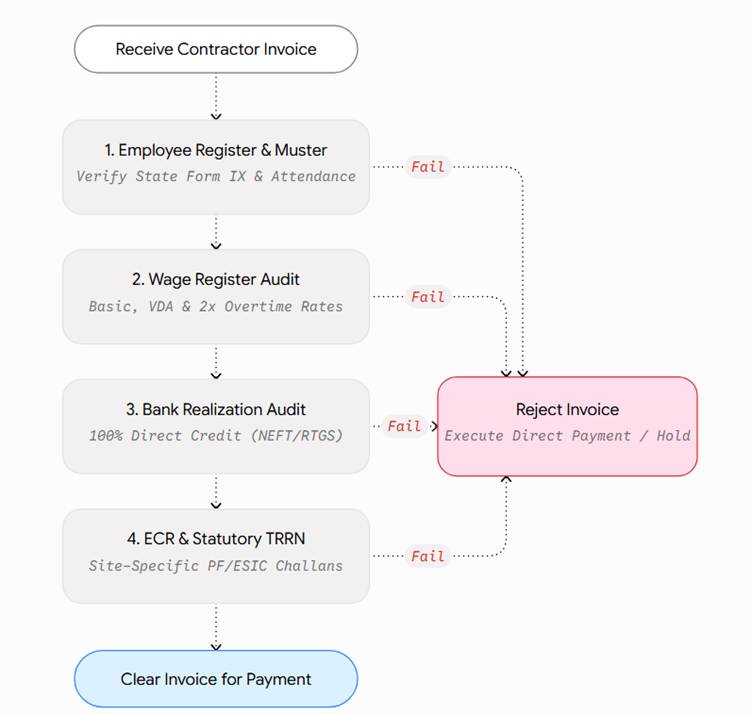
Key insight: A failure at the bank realization or TRRN stage represents an active statutory default, immediately shifting direct payment liability to the principal employer under Section 55(3) of the OSH Code.
The End of Cash Wages: Electronic Disbursement Proof
Section 55(2) of the OSH Code modernized wage disbursement by requiring contractors to pay wages via electronic bank transfer. Consequently, a physical signature on a wage register provides insufficient evidentiary proof of payment. The contractor must submit a Bank Realization Certificate or a digitally authenticated NEFT/RTGS transaction statement that perfectly reconciles with the net payable amounts listed in the statutory wage register.
Social Security Remittances: ECR and TRRN Verification
To prevent the Employees’ Provident Fund Organisation (EPFO) from executing recovery proceedings against the principal employer for a contractor’s default, management must inspect the following documents in accordance with the Code on Social Security, 2020 and its 2026 Rules:
- Site-Specific Electronic Challan cum Return (ECR): The ECR must explicitly list the UANs and names of the exact workers deployed at the specific establishment. Refuse consolidated ECRs that mask individual worker allocations across multiple client sites.
- Temporary Return Reference Number (TRRN) Receipt: The TRRN receipt, generated by the EPFO portal, acts as the official legal proof that the bank cleared the PF remittance.
- ESIC Contribution History: A localized printout proving that health insurance contributions were remitted for the specific Insurance Practitioner (IP) numbers deployed on-site during that billing cycle.
Explicit Statutory Penalties for Non-Compliance
Failing to verify these registers exposes the principal employer to direct statutory action:
- Code on Wages Penalties (Section 54): If the contractor underpays workers and the principal employer fails to cure the default, the principal employer faces fines up to ₹50,000 under Section 54(1)(a) for the underpayment. Repeat underpayment offences carry imprisonment of up to three months under Section 54(1)(b). Contraventions regarding the failure to maintain or inspect registers attract a fine of up to ₹20,000 under Section 54(1)(c).
- OSH Code Penalties (Section 94): While Section 94 specifically imposes fines ranging from ₹2,00,000 to ₹3,00,000 for operating without statutory registration, specific violations of Section 55(3) regarding contract labour wage defaults attract separate penal action under the Code’s residual penalty provisions.
- EPFO Recovery (Section 129 of the Social Security Code): Assessment officers possess the authority to execute recovery proceedings directly against the principal employer’s bank accounts for unpaid PF contributions, alongside levying penal damages and statutory interest of 12 percent per annum.
What Employers Must Do Now [FREE]
To structurally insulate the organization from contractor defaults, corporate HR and finance heads must execute the following protocol:
- Adopt State-Specific Form Compliance: Discard all legacy contract labour compliance manuals. Direct your compliance officers to map the exact Form numbers required by the specific State OSH Rules where each physical facility operates.
- Implement a “No Register, No Payment” Policy: Amend all Master Service Agreements (MSAs) to state that invoices submitted without the corresponding state-mandated wage register, muster roll, TRRN, and bank transfer statements will be automatically rejected.
- Establish a Digital Vendor Compliance Portal: Force contractors to upload digital PDFs of statutory registers and bank statements prior to initiating the accounts payable workflow.
- Execute Sample Audits: Conduct random interviews with 5 percent of the contract workforce monthly. Verify that the wages credited to their bank accounts match the exact figures claimed in the contractor’s wage register.
Are you facing an issue regarding contractor compliance, invoice verification, or labour law registers? Miscalculating compliance can lead to severe statutory penalties. Fill out the Claim Your Free Confidential Consultation form on our homepage, and our legal team at Key4Comply will assist you instantly.
Disclaimer: All articles, blogs, guides, and resources published on this website relate to Indian labour laws and compliance frameworks. The content is provided for general informational and educational purposes only and must not be construed as legal advice. Readers should consult our legal team or a qualified advocate for advice on specific workplace disputes or compliance audits.