 Total Visitors
 Online Users
 Today
 Yesterday


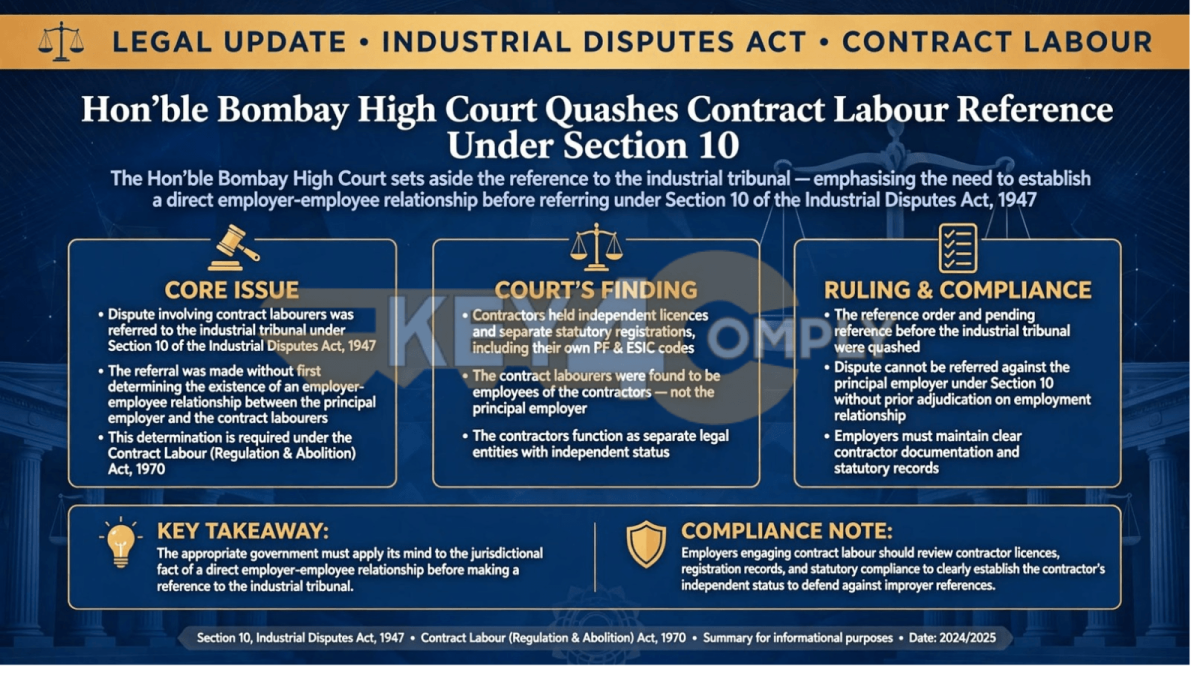
The Hon’ble Bombay High Court has set aside a reference order that had sent a dispute involving contract labourers to an industrial tribunal under Section 10 of the Industrial Disputes Act, 1947. The core issue was whether the appropriate government could make such a reference without first determining the existence of an employer-employee relationship between the principal employer and the contract labourers under the Contract Labour (Regulation and Abolition) Act, 1970.
The court observed that the contractors engaged by the principal employer held independent licences and separate statutory registrations, including their own provident fund and ESIC codes. These facts pointed to a separate legal identity for the contractors. The contract labourers were therefore employees of the contractors and not of the principal employer. On this basis, the court held that the reference order had been passed without application of mind and without considering the legal position that a dispute concerning contract labourers cannot be referred against the principal employer under Section 10 of the Industrial Disputes Act without prior adjudication under the Contract Labour (Regulation and Abolition) Act.
The reference order and the pending reference before the industrial tribunal were quashed. The ruling reinforces a practical point for employers and compliance teams: before a dispute involving contract labour is referred to an industrial tribunal, the appropriate government must apply its mind to the jurisdictional fact of whether a direct employer-employee relationship exists. Where contractors operate as independent entities with their own licences and statutory registrations, a dispute raised by a union representing contract labourers against the principal employer is not maintainable under the Industrial Disputes Act.
Employers engaging contract labour should review their contractor documentation, licence records and statutory registration status to ensure that the separate legal identity of contractors is clearly established and can be demonstrated if a dispute arises.
Disclaimer: This post is provided for general informational and awareness purposes only. It does not constitute legal advice, a legal opinion, or a substitute for professional consultation. The summary is based on a publicly available case note and may not capture every factual detail, procedural nuance, or subsequent development. Court judgments are fact-specific, and the principles discussed may not apply uniformly to every situation. Employers, contractors, workers and unions should verify the full text of the judgment and seek advice from a qualified labour law professional before taking any action based on this content. The author and publisher disclaim any liability for any loss or damage arising from reliance on this information.