 Total Visitors
 Online Users
 Today
 Yesterday


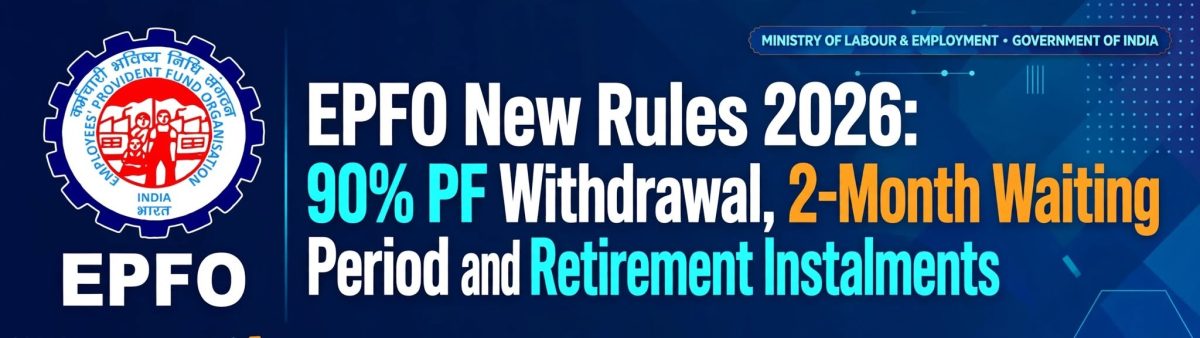
The Employees’ Provident Fund Organisation has approved a set of changes that alter how members access their retirement savings, both during working life and after retirement. The decisions were taken at the Central Board of Trustees meeting on 19 November 2026 and reverse two earlier positions while introducing a new payout option.
The first change concerns how much a member can withdraw. The minimum balance required to be retained in the PF account has been reduced from 25 per cent to 10 per cent. This means an eligible member can now withdraw up to 90 per cent of the balance, instead of the earlier ceiling of 75 per cent. The move is aimed at giving members greater access to their own savings during periods of financial need, though every withdrawal reduces the amount that would otherwise continue to earn interest until retirement.
The second change addresses the waiting period after job loss. The window for final PF settlement after unemployment has been cut from 12 months to two months. The 12-month rule had been introduced in October 2025. With the reversal, a member who loses a job can seek settlement after two months of unemployment rather than waiting a full year. The waiting period for pension withdrawal under the Employees’ Pension Scheme remains unchanged at 36 months.
The third and most structural change is the introduction of a Systematic Withdrawal Plan for retiring members. Instead of withdrawing the entire corpus as a lump sum, a member can opt to receive the savings in monthly, quarterly or half-yearly instalments. The plan is voluntary. A member can choose full systematic withdrawals, take a partial lump sum upfront and receive periodic payments on the remaining balance, or withdraw only the interest generated by the corpus. The unwithdrawn balance continues to earn the prevailing EPF interest rate, and the member can stop the plan at any point and withdraw the remaining amount. In the event of death, the nominee can either withdraw the remaining corpus or continue receiving the instalments. The facility is expected to be operational after the necessary amendments to the EPF Scheme are notified, which is anticipated in around two months.
The fourth change extends the retirement savings framework beyond the traditional employer-employee relationship. The Board has proposed UAN-linked voluntary contribution mechanisms that would allow gig workers, platform workers, domestic workers and other informal-sector workers to contribute directly to retirement savings. The proposal contemplates both direct voluntary contributions and third-party micro-contributions, such as customer tips, without depending on a conventional payroll system. This is still at the proposal stage and will require amendments and approvals before implementation.
Separately, the Board has granted in-principle approval for the EPFO to invest up to 3 per cent of new investment inflows in eligible Alternative Investment Funds, initially routed through government-backed entities and subject to existing safeguards.
For employers and payroll teams, the immediate operational point is the reduction in the waiting period and the higher withdrawal ceiling, which will affect separation-related settlements. The SWP and the gig-worker framework are forward-looking changes that will need to be tracked as the scheme amendments are notified. For members, the flexibility is real, but so is the trade-off. A higher withdrawal today means a smaller corpus compounding for retirement, and the choice between a lump sum and instalments should be made with that arithmetic in view.
If you need support with this process, you can reach us at the contact number listed on our website or write to support@key4comply.com with your detailed query. Please note that this is a chargeable service.
Disclaimer: This post is provided for general informational and awareness purposes only. It does not constitute legal advice, a legal opinion, or a substitute for professional consultation. The summary is based on publicly available reporting of the decisions of the EPFO Central Board of Trustees meeting held on 19 November 2026 and may not reflect every procedural detail, subsequent amendment, or individual account circumstance. Several of the changes described, including the Systematic Withdrawal Plan and the UAN-linked voluntary contribution framework for gig and platform workers, are proposals or decisions in principle that require amendments to the EPF Scheme and further approvals before they take effect. The operational timelines, eligibility conditions and tax treatment of withdrawals and instalments will depend on the notified rules and the specific facts of each case. Members and employers should verify the current position through official EPFO channels and seek advice from a qualified financial or legal professional before acting on this information. The support service mentioned in this post is a chargeable professional service and is not connected to EPFO or any government authority. The author and publisher disclaim any liability for any loss or damage arising from reliance on this information.