 Total Visitors
 Online Users
 Today
 Yesterday


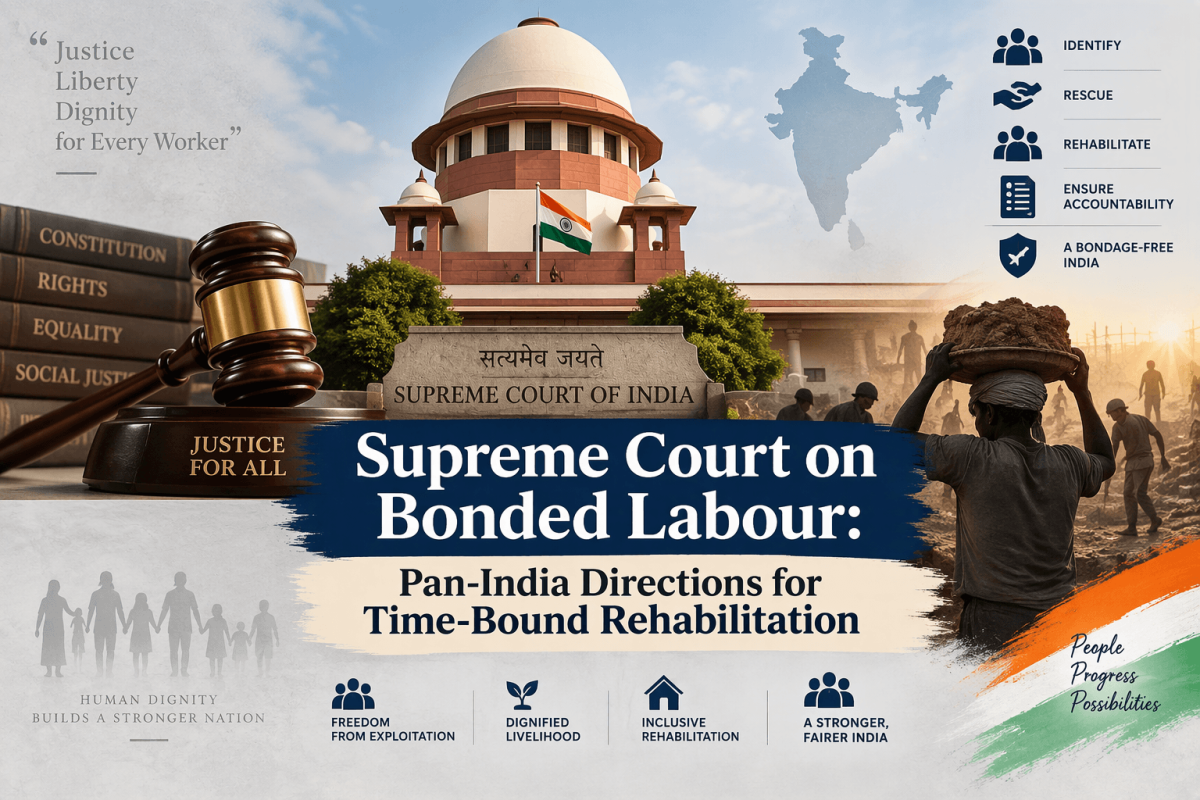
The Supreme Court has issued a set of pan-India directions on the identification, release, and rehabilitation of bonded labourers, and the reasoning behind them deserves attention from every organisation that engages labour, directly or through contractors.
The Court’s central holding is that the State’s constitutional obligation does not end with rescue. Invoking Articles 21 and 23, the Bench observed that freedom from bondage cannot be secured by the act of release alone. Unless release is accompanied by timely financial assistance and meaningful rehabilitation, a person freed from exploitation may be driven by economic necessity straight back into the same conditions. The Court put it plainly: rehabilitation delayed may, in substance, amount to rehabilitation denied.
Several operational timelines now flow from that principle. Complaints of bonded labour should ordinarily be verified within 24 hours, and release certificates should ordinarily be issued within 24 hours of a determination that bonded labour exists. Immediate financial assistance under the rehabilitation scheme should ordinarily be disbursed within seven days of the release certificate. Individual rehabilitation plans should be prepared, and rehabilitation measures initiated, within 90 days of rescue. The Union government has been directed to ensure uniform implementation of the revised Standard Operating Procedure across all States and Union Territories, with compliance expected within six months, and to issue supplementary guidelines in consultation with the National Human Rights Commission within three months.
Two further points carry weight for employers and compliance teams. First, the Court held that financial assistance cannot be withheld merely because a criminal investigation or prosecution against the employer is pending. The rehabilitation entitlement is independent of the criminal process. Second, the Court directed that differences in release certificate formats between States should not obstruct rehabilitation, and that a uniform format recognised across jurisdictions should be prescribed. Inter-State coordination mechanisms, nodal officers, Vigilance Committees, and digital monitoring through the designated portal are all to be strengthened, and released labourers are to receive continued livelihood support with periodic monitoring for at least a year.
The matter remains before the Court for continued monitoring, with compliance affidavits directed from the authorities. For organisations, the practical implication is that the legal exposure around bonded labour does not end when a worker is released or repatriated. The rehabilitation obligation is now time-bound, and failures at the rehabilitation stage are treated as failures of the constitutional guarantee itself.
Disclaimer: This post is provided for general informational and awareness purposes only. It does not constitute legal advice, a legal opinion, or a substitute for professional consultation. The summary is based on a judgment of the Supreme Court dated 2 November 2026 and publicly available reports of the directions issued, and may not capture every factual detail, procedural nuance, or subsequent development. The directions are addressed primarily to the Union and State authorities, and their application to any particular employer or establishment will depend on the specific facts. Employers, contractors, workers, and advisers should verify the full text of the judgment and the current status of the Standard Operating Procedure and rehabilitation scheme, and seek advice from a qualified labour law professional before taking any action based on this content. The author and publisher disclaim any liability for any loss or damage arising from reliance on this information.