 Total Visitors
 Online Users
 Today
 Yesterday


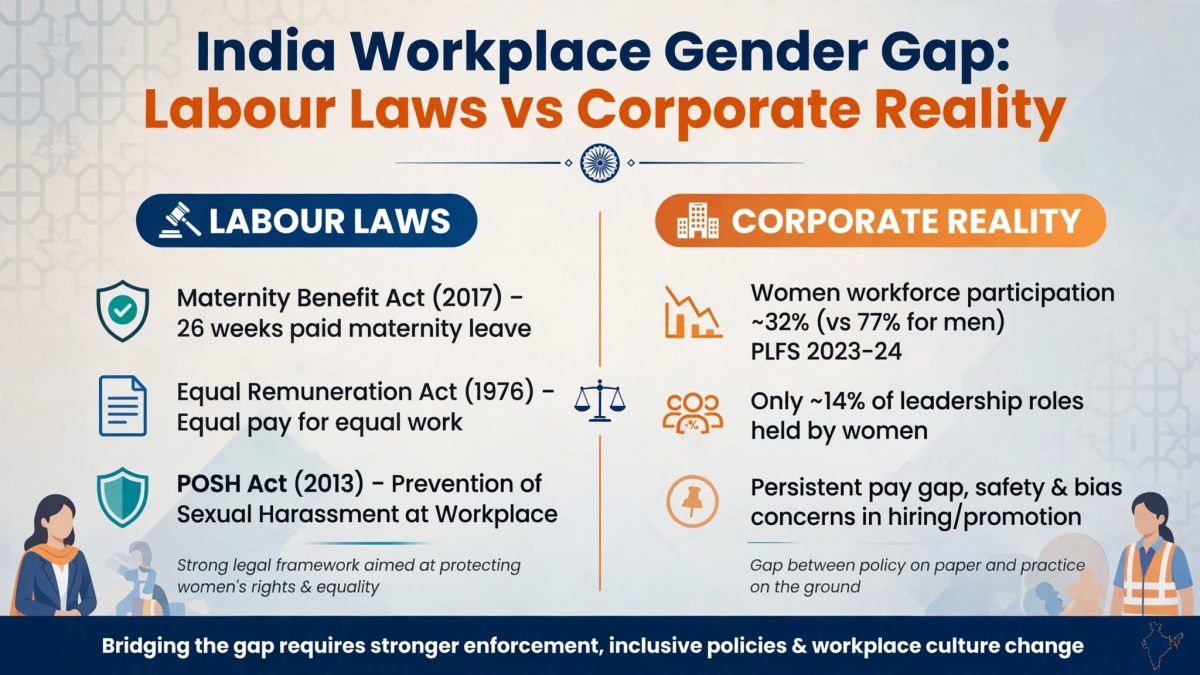
High-profile appointments of women to corner offices across Indian banking, financial services, and technology often create the impression that corporate gender parity is within reach. Yet broader labour market and boardroom data tell a more sobering story. Despite an extensive framework of constitutional guarantees and workplace legislation, women in India continue to face steep drop-offs in mid-management pipelines, persistent wage disparities, and under-representation in executive leadership.
Data from the Ministry of Statistics and Programme Implementation (MoSPI) under the Periodic Labour Force Survey (PLFS) illustrates this structural divide. While overall female Labour Force Participation Rate (age 15 and above, usual status) reached 40.0 percent in 2025, much of that expansion occurred in rural self-employment and agricultural activity rather than formal urban salaried roles. In urban centres, female participation in usual status stood at 27.7 percent (and hovered near 25.4 percent in current weekly status), while average monthly earnings for women in regular salaried jobs trailed male earnings by roughly 24 percent nationally and even more sharply in urban pockets.
At the senior corporate tier, the gap is equally pronounced. A 2026 CFA Institute study of Indian listed companies found that women held only 12.4 percent of Key Managerial Personnel (KMP) roles in FY25, with nearly two-thirds of surveyed firms reporting zero women in KMP positions. This contrast highlights a recurring compliance reality: statutory mandates can prohibit overt discrimination, but formal compliance alone does not dismantle structural barriers to retention and advancement.
Constitutional and Statutory Framework Governing Workplace Gender Equality
Indian labour and corporate legislation already contains comprehensive safeguards addressing equal pay, recruitment fairness, maternity protection, workplace safety, and board representation:
1. Equal Pay and Non-Discrimination in Hiring (Code on Wages, 2019)
Rooted in Articles 14, 15, 16, and 39(d) of the Constitution of India and the Supreme Court ruling in Randhir Singh v. Union of India ((1982) 1 SCC 618), equal remuneration is now governed by Section 3 of the Code on Wages, 2019 (in force since November 21, 2025, read with the Code on Wages (Central) Rules, 2026 notified on May 8, 2026), which subsumed the Equal Remuneration Act, 1976. Section 3(1) prohibits gender-based wage discrimination for the same work or work of a similar nature. Crucially, Section 3(2)(ii) extends this prohibition to recruitment for the same or similar work and to the conditions of employment (including promotions and training), while Section 3(2)(i) bars employers from lowering existing wage rates to achieve parity.
2. Maternity Leave, Creche Facilities, and Return-to-Work Protections (Code on Social Security, 2020)
Subsuming the Maternity Benefit Act, 1961, Chapter VI (Sections 59 to 72) of the Code on Social Security, 2020 entitles eligible women employees who have worked at least 80 days in the preceding 12 months to 26 weeks of paid maternity leave for up to two surviving children (and 12 weeks for adopting and commissioning mothers) under Section 60. Section 66 guarantees two daily nursing breaks until the child turns 15 months, and Section 68 prohibits dismissal or adverse alteration of service conditions during maternity absence. Additionally, Section 67(1) mandates every establishment employing 50 or more employees to provide a creche facility within a prescribed distance, allowing four daily visits.
3. Night-Shift Employment and Safety Safeguards (OSHWC Code, 2020)
Replacing legacy factory restrictions that often excluded women from higher-paying operational shifts, Section 43 of the Occupational Safety, Health and Working Conditions (OSHWC) Code, 2020 allows women to work in all establishments across all categories of work, including before 6:00 a.m. and after 7:00 p.m. Such deployment is subject to the employee’s prior written consent and strict employer adherence to safety, transport, security, and working-hour conditions notified by the appropriate Government.
4. Workplace Safety and Grievance Representation (POSH Act, 2013 and IR Code, 2020)
Under Section 4 of the Sexual Harassment of Women at Workplace (Prevention, Prohibition and Redressal) Act, 2013 (codifying the guidelines in Vishaka v. State of Rajasthan, (1997) 6 SCC 241), every workplace with 10 or more workers must constitute an Internal Committee (IC) and submit annual compliance filings under Section 21. In Aureliano Fernandes v. State of Goa ((2024) 1 SCC 632), the Supreme Court directed rigorous institutional audits to close IC constitution gaps across public and private bodies. Complementing this, Section 4(4) of the Industrial Relations Code, 2020 mandates proportional representation of women on bipartite Grievance Redressal Committees in establishments employing 20 or more workers.
5. Corporate Board Diversity Mandates (Companies Act, 2013 and SEBI Regulations)
Under the second proviso to Section 149(1) of the Companies Act, 2013 read with Rule 3 of the Companies (Appointment and Qualification of Directors) Rules, 2014, every listed company and every public company with paid-up share capital of Rs. 100 crore or more or turnover of Rs. 300 crore or more must appoint at least one woman director. Regulation 17(1)(a) of the SEBI (Listing Obligations and Disclosure Requirements) Regulations, 2015 further requires at least one independent woman director on the boards of the top 1,000 listed entities.
Why Legal Compliance Alone Has Not Closed the Gap
Despite these clear statutory rules, four structural friction points continue to slow workplace parity:
- Tokenistic Board Compliance: Many listed companies satisfy Section 149(1) of the Companies Act, 2013 by appointing a single woman non-executive director without building women-led profit-and-loss roles that feed into Chief Executive Officer or Chief Financial Officer succession.
- Unpaid Care Burden and Weak Creche Enforcement: Time-use surveys consistently show that Indian women perform nearly five hours more unpaid domestic and caregiving work per day than men. Because creche mandates under Section 67 of the Code on Social Security, 2020 lack uniform state-level inspection and India still lacks statutory private-sector paternity leave, caregiving duties frequently trigger mid-career exits.
- Opaque Pay Bands and Role Segregation: While Section 3 of the Code on Wages, 2019 mandates equal pay for identical work, wage gaps persist through occupational segregation, discretionary performance bonuses, and negotiation disparities at lateral hiring stages.
- Fear of Retaliation in Informal Networks: Even where an Internal Committee exists on paper under the POSH Act, 2013, informal exclusion from sponsorship networks and subtle workplace bias remain difficult to address through formal adjudication alone.
Actionable Governance Steps for Employers and HR Leaders [FREE]
- Conduct Annual Gender Pay Equity Audits: Benchmark base pay, variable incentives, and promotion velocity across comparable job grades to verify compliance with Section 3 of the Code on Wages, 2019.
- Operationalise Creche and Return-to-Work Support: Establish verified creche partnerships under Section 67 of the Code on Social Security, 2020 and offer structured flexible-work transitions under Section 60(5) following maternity leave.
- Track Mid-Management Succession Metrics: Move beyond minimum board compliance by setting transparent succession targets for Key Managerial Personnel and operational leadership roles.
Disclaimer: This article is prepared strictly for general informational, educational, and compliance awareness purposes and does not constitute formal legal advice, a legal opinion, or solicitation of professional services. Statutory obligations under the Code on Wages, 2019, the Code on Social Security, 2020, the Occupational Safety, Health and Working Conditions Code, 2020, the Sexual Harassment of Women at Workplace (Prevention, Prohibition and Redressal) Act, 2013, and the Companies Act, 2013 are subject to central and state rules, administrative notifications, and judicial interpretation. Employers, HR professionals, and employees should consult a qualified labour and corporate law practitioner before framing internal policies or initiating legal action.