 Total Visitors
 Online Users
 Today
 Yesterday


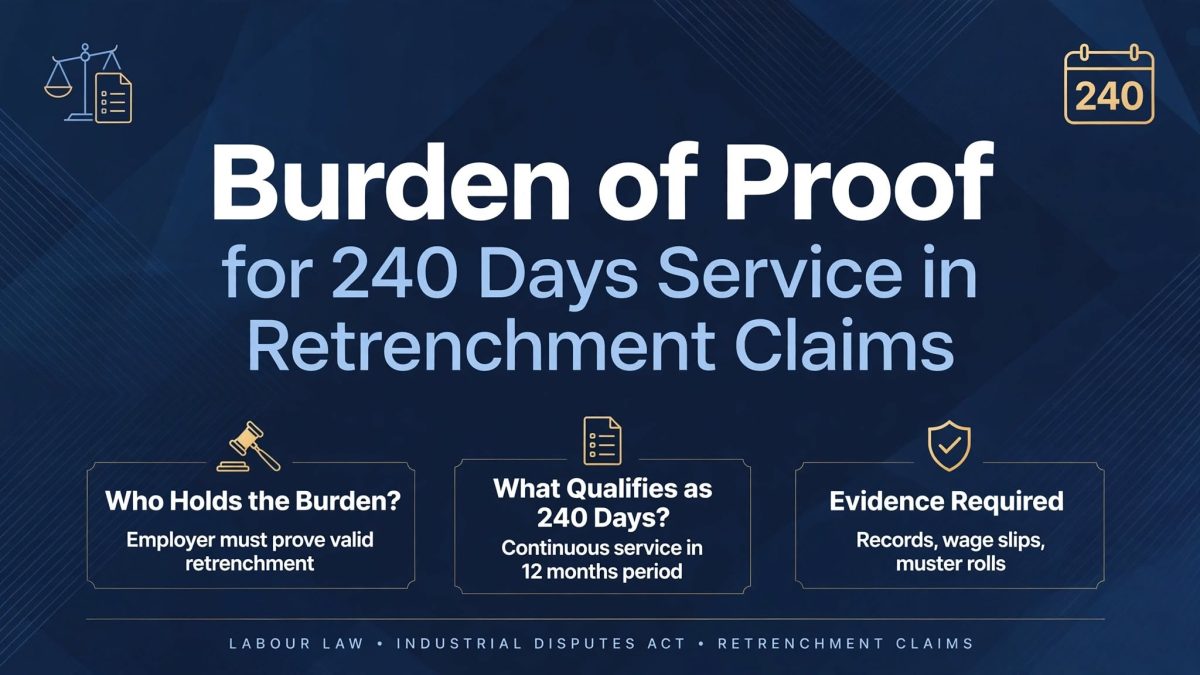
In industrial adjudication across India, claims of illegal termination frequently hinge on a single factual threshold: whether the claimant actually worked for 240 days in the twelve months preceding the date of termination. While labour legislation protects workers against arbitrary retrenchment, courts require disciplined evidentiary standards before fastening statutory liability on an employer.
In Range Forest Officer v. S.T. Hadimani (Civil Appeal Nos. 1283-1284 of 2002, decided on February 15, 2002, reported at (2002) 3 SCC 25, 2002 (1) SCR 1080, and AIR 2002 SC 1147), a Division Bench of the Supreme Court of India comprising Justice B.N. Kirpal and Justice Arijit Pasayat settled the foundational rule on evidentiary onus. The Court ruled that when an employer disputes the duration of engagement, the initial burden rests squarely on the claimant to prove 240 days of service through cogent evidence, and a self-serving affidavit alone cannot discharge that burden.
Factual Background and Procedural History
The respondent workman raised an industrial dispute alleging that he had worked for 240 days under the Range Forest Officer in Karnataka and that his services were terminated without paying retrenchment compensation. The appellant department denied the claim in its entirety, asserting that the claimant had never completed 240 days of work.
By an award dated August 10, 1998, the Labour Court ruled in favour of the workman. In reaching its conclusion, the Tribunal held that the burden lay on the management to justify the termination and treated the workman’s own affidavit as sufficient proof that he had worked for 240 days in the preceding year. After the High Court declined to interfere with the award, the Range Forest Officer appealed to the Supreme Court.
Ratio Decidendi and Core Legal Findings
Setting aside the Tribunal’s award, the Supreme Court laid down three clear rules of industrial evidence:
1. Initial Onus Lies on the Claimant
When a worker asserts completion of 240 days of continuous service and the employer specifically denies that assertion in its pleadings, the onus is on the claimant to lead credible evidence establishing actual work during the twelve-month period preceding termination. The Tribunal cannot reverse this sequence by demanding that the employer prove a negative fact at the threshold.
2. A Self-Serving Affidavit Is Not Conclusive Proof
The Court held that filing an affidavit amounts only to the claimant’s own statement in his favour. Without supporting material such as wage receipts, salary vouchers, bank transfer records, or an order of appointment or engagement covering the relevant period, a bare affidavit cannot form the legal basis for holding that a workman worked for 240 days.
3. Jurisdictional Sequence Before Examining Termination Validity
The Supreme Court clarified that a Labour Court or Industrial Tribunal must first record a legally sustainable finding on whether the claimant completed 240 days of service. Only after that threshold is crossed does the statutory obligation to pay retrenchment compensation arise. Because the claimant produced no documentary proof of engagement or wages, the Court held that the award could not stand, while recording the State’s fair offer to re-engage the respondent on compassionate grounds on his previous terms.
Subsequent Judicial Evolution and Active Labour Code Provisions
Following Hadimani, the Supreme Court further refined how evidentiary rules apply when daily-wage or casual workers lack formal appointment letters:
- Harmonisation by a Three-Judge Bench: In R.M. Yellatti v. Assistant Executive Engineer ((2006) 1 SCC 106) and Municipal Corporation, Faridabad v. Siri Niwas ((2004) 8 SCC 195), the Supreme Court reaffirmed Hadimani while clarifying that strict provisions of the Indian Evidence Act do not mechanically govern industrial tribunals. Once a worker steps into the witness box and produces whatever primary or secondary material is in their possession, such as work certificates or attendance slips, and formally calls upon the management to produce muster rolls or wage registers in its exclusive custody, an unexplained refusal by the employer to produce those records may justify drawing an adverse inference. However, non-production of records by an employer cannot be used as a shortcut where the worker has laid no foundational evidence at all.
- Alignment with the Industrial Relations Code, 2020: The legacy provisions of Sections 25B and 25F of the Industrial Disputes Act, 1947 have now been subsumed into the Industrial Relations Code, 2020 (in force since November 21, 2025, alongside the Industrial Relations (Central) Rules, 2026 notified on May 8, 2026). Under Section 66 of the Industrial Relations Code, 2020, a worker is deemed to be in continuous service for one year if they have actually worked under the employer for not less than 240 days during the preceding twelve months (or 190 days for below-ground mine work). Only upon satisfying Section 66 does a worker qualify for mandatory notice and retrenchment compensation under Section 70 (and Worker Re-skilling Fund contributions under Section 83) of the Code.
Practical Compliance Takeaways for Employers and HR Teams [FREE]
- Maintain Complete Attendance and Wage Registers: Under the Occupational Safety, Health and Working Conditions Code, 2020 and the Code on Wages, 2019, establishments must preserve accurate electronic or physical muster rolls, attendance logs, and wage disbursement records for all regular, fixed-term, casual, and daily-rated workers.
- Issue Written Engagement Letters: Issuing clear written appointment or fixed-term engagement letters specifying start dates, project duration, and payment terms prevents factual ambiguity if a temporary worker later alleges continuous employment.
- Produce Authenticated Records Before Tribunals: When defending a termination reference before a Labour Court or Industrial Tribunal, employers should proactively file certified extracts of muster rolls and payment registers for the twelve months preceding separation rather than relying solely on technical objections.
Disclaimer: This article is prepared strictly for general informational, educational, and compliance awareness purposes and does not constitute formal legal advice, a legal opinion, or solicitation of professional services. Evidentiary assessments in labour disputes depend heavily on the specific pleadings, oral testimony, and documentary records produced before the adjudicating forum under the Industrial Relations Code, 2020 and applicable state rules. Employers, HR professionals, and workers should consult a qualified labour law practitioner before initiating or defending any industrial adjudication proceeding.