 Total Visitors
 Online Users
 Today
 Yesterday


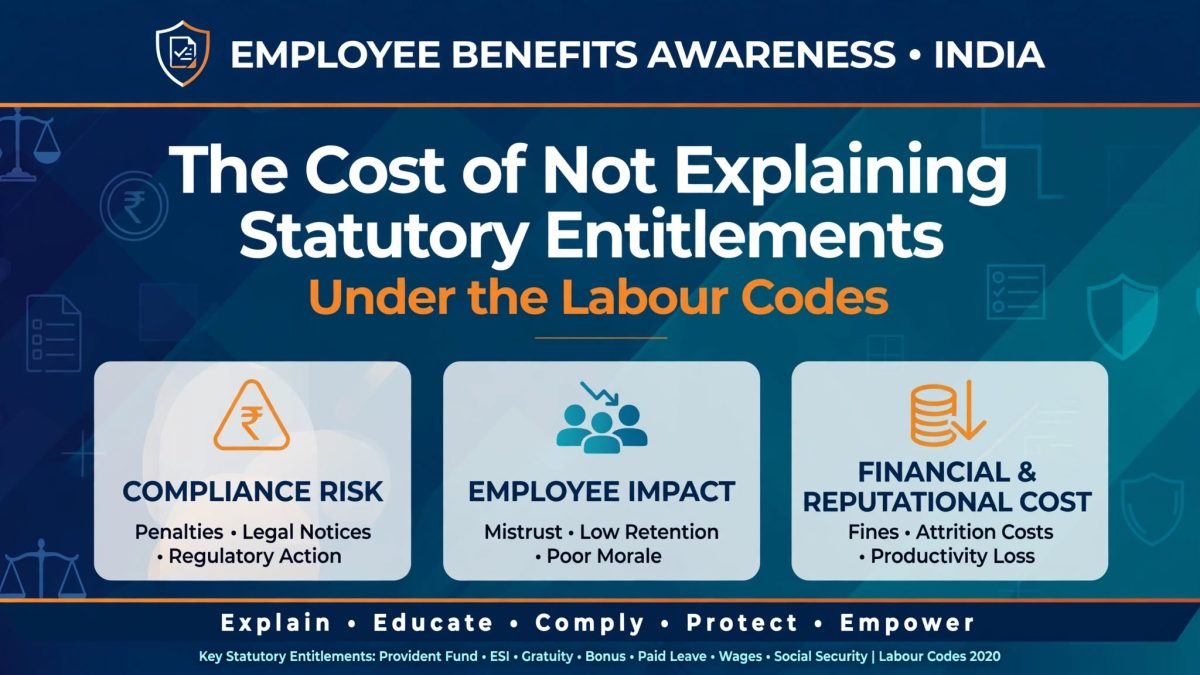
There is an uncomfortable pattern in how statutory benefits are communicated inside many organisations. The law provides the floor. The policy document exists. The payroll deduction is processed. What is often missing is a clear, repeated explanation of what the employee is actually owed.
The consequences show up at the point of exit. Employees leave without knowing how their separation has been classified, and that classification carries legal weight. Under the Code on Wages, 2019, a retrenched worker with one year of continuous service is entitled to retrenchment compensation at fifteen days of average pay for every completed year, along with notice or wages in lieu. A voluntary resignation usually does not attract that entitlement. In practice, many exits sit in a grey zone, and the label chosen can quietly determine whether a statutory obligation is triggered. Final wages are also due within two working days of the last day under the Code, a timeline that many organisations still do not meet.
This is not confined to separation benefits. Awareness of what the social security framework already guarantees is thin. Under the Code on Social Security, 2020, insured workers and their dependants are entitled to six benefits, including full medical care from the first day of insurable employment and cash benefits for sickness, maternity, disablement and dependants. The contribution leaves the salary every month, yet the benefits often sit unclaimed because nobody explains them in plain terms.
The wage structure itself has become a source of quiet exposure. The Code on Wages, 2019, caps excluded allowances at fifty percent of total remuneration. If allowances exceed that ceiling, the excess is added back to wages for statutory calculations, which increases liabilities tied to provident fund, gratuity and other benefits. An employee who was never told how their pay is structured may only discover the gap when a benefit is calculated at a figure lower than expected, or when a compliance review surfaces a shortfall.
The organisational temptation to keep things vague is understandable. Clarity invites questions. Questions can lead to claims. A workforce that does not know the full extent of its entitlements is, for a time, easier to manage. But that quiet preference carries its own risk. Statutory benefits accrue by operation of law, not by employer discretion. An employee who later discovers an entitlement that was never explained is not a hypothetical concern. It is a dispute waiting for a trigger.
The more durable position is to treat benefits education as part of governance rather than a discretionary HR courtesy. That means explaining the structure of pay in plain terms, distinguishing between what is discretionary and what is statutory, and ensuring that exit conversations are documented with the same care as entry conversations. It is less about charity and more about reducing the chance that a preventable misunderstanding becomes a legal matter.
Disclaimer: This post is provided for general informational and awareness purposes only. It does not constitute legal advice, a legal opinion, or a substitute for professional consultation. The discussion draws on publicly available commentary and reported examples and may not reflect the legal position in every establishment or for every category of worker. The four Labour Codes came into force on 21 November 2025, and the Central Rules were notified on 8 May 2026, but state-level rules and transitional arrangements continue to evolve. Statutory entitlements are fact-specific and depend on thresholds, continuity of service, the applicable wage ceiling and the classification of the exit. Employers and employees should verify the current text of the Code on Wages, 2019, the Code on Social Security, 2020, and the relevant state rules, and seek advice from a qualified labour law professional before taking any action based on this content. The author and publisher disclaim any liability for any loss or damage arising from reliance on this information.