 Total Visitors
 Online Users
 Today
 Yesterday


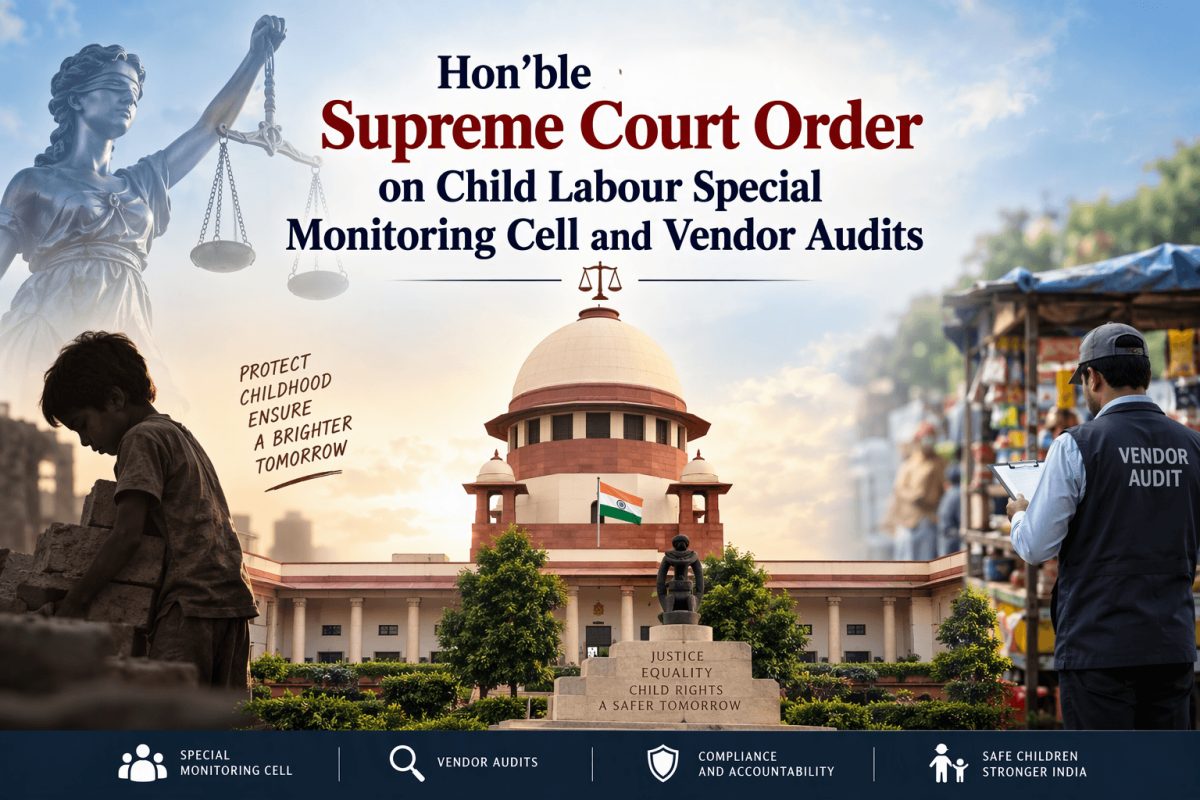
Summary of the Hon’ble Supreme Court Order
On October 29, 2026, a Division Bench of the Hon’ble Supreme Court of India comprising Hon’ble Justice S.V.N. Bhatti and Justice N.V. Anjaria passed its final order disposing of Health For Millions v. Union of India & Ors. (Writ Petition (Civil) No. 501 of 2009; 2026 LiveLaw (SC) 1127).
The public interest litigation, originally filed in 2009, had challenged the constitutional validity of the pre-amendment proviso to Section 3 of the Child Labour (Prohibition and Regulation) Act, 1986, pointing out widespread evasion of statutory prohibitions against child labour. During the pendency of the writ petition, Parliament enacted the Child Labour (Prohibition and Regulation) Amendment Act, 2016 (Act No. 35 of 2016), renaming the statute the Child and Adolescent Labour (Prohibition and Regulation) Act, 1986 and overhauling Sections 3 and 3A.
Recognizing that the legislative amendments had addressed the petitioner’s original statutory challenge, the Hon’ble Supreme Court closed the petition with a targeted executive enforcement mandate. The Bench directed the Second Respondent (Secretary, Ministry of Women and Child Development) to constitute a dedicated Special Cell to monitor the implementation and enforcement of the amended Act and to issue necessary directions to state enforcing agencies through the Chief Secretaries of the respective States.
Distinguishing the Judicial Directive from Statutory Supply Chain Exposure
A rigorous legal reading of Health For Millions v. Union of India requires separating what the Hon’ble Supreme Court specifically ordered from the broader operational risks faced by corporate establishments:
- Scope of the Judicial Holding: The October 29, 2026 order is an administrative and enforcement directive aimed at the Central and State Governments. The Court did not create a new substantive doctrine of vicarious or strict supply chain liability for principal employers beyond the text of the statute.
- Pre-Existing Statutory Framework Under the Amended 1986 Act:
- Section 3 (Complete Ban on Child Labour): No child below 14 years of age may be employed or permitted to work in any occupation or process. The narrow family-enterprise and audiovisual exceptions do not apply to commercial manufacturing, warehousing, or subcontracted vendor operations.
- Section 3A (Ban on Adolescent Labour in Hazardous Processes): No adolescent between 14 and 18 years of age may be employed or permitted to work in any hazardous occupation or process specified in the Schedule to the Act.
- Section 17A (District Magistrates as Nodal Enforcement Authorities): The District Magistrate is empowered to exercise duties and powers to ensure that the provisions of the Act are properly carried out through district task forces and periodic inspections.
- Section 14 and Section 14B (Penalties and Rehabilitation Fund): Contravention of Section 3 or Section 3A attracts imprisonment between six months and two years, or a fine between Rs. 20,000 and Rs. 50,000, or both (with repeat offences carrying one to three years of imprisonment). Additionally, pursuant to the Hon’ble Supreme Court’s baseline mandate in M.C. Mehta v. State of Tamil Nadu (AIR 1997 SC 699) and Section 14B of the Act, statutory recoveries are credited to the Child and Adolescent Labour Rehabilitation Fund.
- Why Principal Employers Face Heightened Operational Risk: While primary criminal liability under Section 14 attaches to the person who employs or permits the underage worker to work, the activation of central monitoring cells and state enforcement drives increases the frequency of unannounced raids at industrial premises, contract packaging units, and third-party vendor sites. Where underage labour is detected inside a principal employer’s premises or under a job-work contractor supervised by the principal employer, labour inspectorates routinely array both the contractor and the principal employer’s occupier or manager in show-cause notices and prosecution complaints, aligning with contractor governance duties under the Occupational Safety, Health and Working Conditions (OSHWC) Code, 2020.
Prudent Risk Mitigation Action Plan for Principal Employers [FREE]
To insulate the establishment and its officers from enforcement exposure during state task force inspections, compliance teams should implement three preventive controls as a matter of prudent corporate governance:
- Conduct Age-Verification Audits Across Outsourced Vendor Sites: Extend internal compliance audits beyond primary factory premises to cover ancillary job-work units, packaging contractors, and loading agencies. Cross-check physical headcounts on the shop floor against the contractor’s attendance and wage registers.
- Require Verified Official Age Proofs Prior to Gate Pass Issuance: Do not rely on self-declarations or unverified affidavits of age. Require contractors to verify the date of birth of every deployed worker using authentic government-issued primary documents, such as a Matriculation or School Leaving Certificate, a Municipal Birth Certificate, or an official government identity card (with sensitive identification digits masked in compliance records). If adolescents aged 14 to 18 are legally engaged in non-hazardous processes, ensure the contractor maintains the mandatory Form A Register under Section 11 and a valid Certificate of Age from a prescribed medical authority.
- Insert Immediate Contract Termination and Indemnity Clauses: Update vendor Master Service Agreements (MSAs) to make compliance with the Child and Adolescent Labour (Prohibition and Regulation) Act, 1986 an express condition precedent. Include clauses allowing immediate contract termination without notice pay upon detection of an underage worker, alongside a right to withhold vendor payouts to cover statutory rehabilitation fund recoveries and legal defence costs.
Disclaimer: This article is published solely for informational and educational purposes to assist human resource professionals, legal practitioners, and corporate compliance teams in understanding judicial and regulatory developments. It does not constitute formal legal advice or a binding legal opinion. Readers are advised to consult qualified labour law counsel and verify applicable state rules before acting upon any information contained herein.