 Total Visitors
 Online Users
 Today
 Yesterday


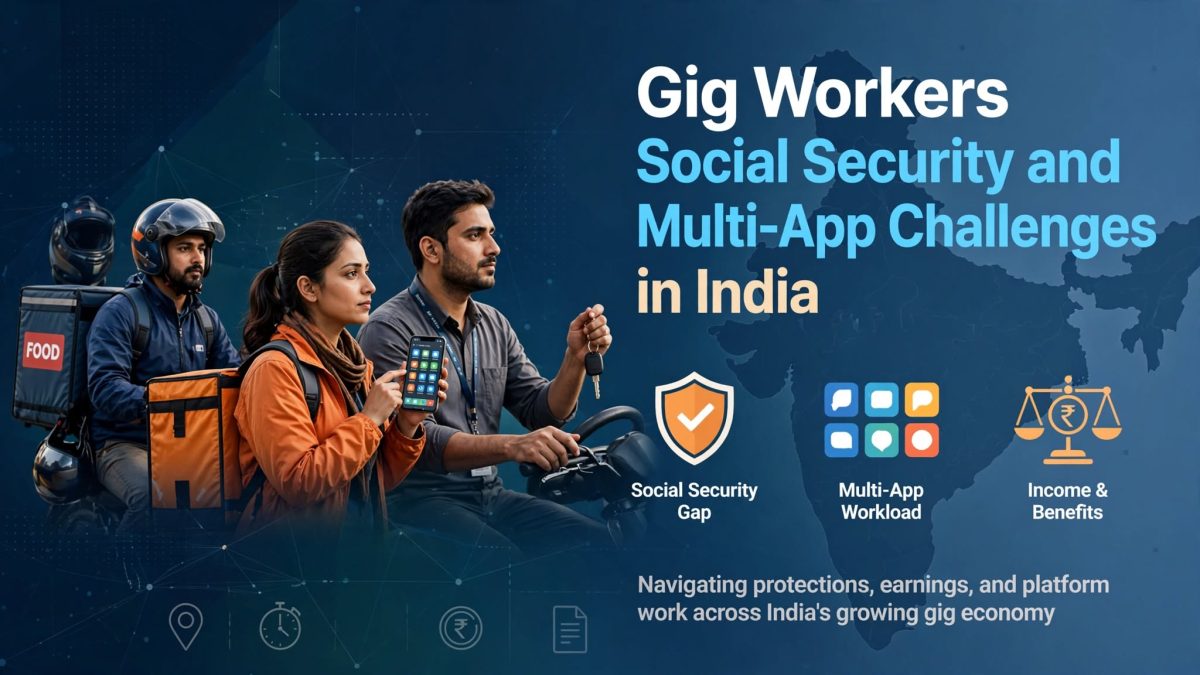
The constitution of the National Social Security Board for Unorganised Workers and Gig and Platform Workers by the Ministry of Labour and Employment on October 30, 2026 marks a major institutional step in bringing app-based workers into India’s formal welfare framework. Operationalising these protections on the ground, however, presents complex administrative and legal challenges. Because gig workers routinely log into multiple digital platforms simultaneously and migrate across states, fragmented employment records threaten to complicate eligibility tracking, contribution calculations, and benefit portability.
For legal practitioners, digital aggregators, and compliance teams, bridging the gap between statutory intent and real-time payroll data is now the central test of India’s new social security architecture.
Statutory Recognition Under the Code on Social Security, 2020
With the four consolidated labour codes brought into force nationwide from November 21, 2025, Indian labour jurisprudence formally moved beyond the traditional binary of master and servant. Under the Code on Social Security, 2020:
- Gig Worker Definition (Section 2(35)): Covers any person who performs work or participates in a work arrangement and earns from such activities outside a traditional employer-employee relationship.
- Platform Work and Worker (Sections 2(60) and 2(61)): Specifically recognises work arrangements in which organisations or individuals use an online platform to access other organisations or individuals to solve specific problems or provide specific services in exchange for payment.
- Welfare Schemes and National Board (Section 114): Empowers the Central Government to frame schemes for gig and platform workers covering life and disability cover, accident insurance, health and maternity benefits, old-age protection, and creche facilities. Under Section 114(6), the National Social Security Board assumes a specialised composition featuring five representatives each from aggregators and gig workers to recommend schemes, monitor implementation, and scrutinise fund expenditure.
Key Legal and Operational Bottlenecks
1. Tracking Multi-App Engagement and Eligibility Thresholds
Unlike factory or office employees attached to a single establishment, delivery riders and cab drivers frequently switch between food delivery, quick-commerce, and ride-hailing apps within the same day. Under the Social Security (Central) Rules, 2026, notified via G.S.R. 344(E) on May 8, 2026, a gig or platform worker must complete at least 90 days of engagement with a single aggregator, or 120 days across multiple aggregators, in a financial year to qualify for central social security schemes.
While the rules count a day of engagement whenever a worker earns any income on a calendar day, accurately aggregating fragmented shift logs across competing platforms without duplication or omission requires seamless API integration with the national e-Shram database.
2. Dual-Cap Aggregator Levy and Transaction Attribution
Section 114(4) of the Code requires aggregators listed in the Seventh Schedule (spanning ride-sharing, food and grocery delivery, logistics, e-marketplaces, and professional services) to contribute to the Social Security Fund established under Section 141. The statute imposes a dual ceiling: the levy must be between 1 percent and 2 percent of the aggregator’s annual turnover (excluding central taxes, levies, and cesses), capped at 5 percent of the amount paid or payable by the aggregator to gig and platform workers.
Under Rule 48 and Rule 49 of the Social Security (Central) Rules, 2026, aggregators must register on the designated portal, electronically share worker engagement particulars, and file self-assessments. Yet, until the Central Government notifies the exact percentage rate and commencement date under Section 114(5), operationalising the fund collection and reconciling payout-linked caps across high-volume, low-ticket transactions remains a sensitive compliance area for platform companies.
3. Overlapping Central and State Legislative Frameworks
Labour falls under Entries 23 and 24 of the Concurrent List in the Seventh Schedule of the Constitution, leading several states to enact independent gig worker laws ahead of central operationalisation. Rajasthan pioneered state-level regulation through the Rajasthan Platform Based Gig Workers (Registration and Welfare) Act, 2023, followed by Karnataka, Bihar, and Jharkhand in 2025.
Many state statutes establish separate state welfare boards and impose transaction-based welfare cesses on aggregators. Without a clear statutory set-off mechanism or data-sharing protocol harmonising central contributions under Section 114 with state welfare levies, aggregators face duplicate compliance filings while migrant workers risk losing benefit continuity when crossing state borders.
Compliance Takeaways for Digital Aggregators
- Audit Worker Onboarding and e-Shram Integration: Ensure all active gig and platform partners aged 16 to 60 are mapped with unique e-Shram Universal Account Numbers (UANs) as mandated under Rule 48 of the Social Security (Central) Rules, 2026.
- Segregate Payout Ledgers: Maintain distinct accounting records separating gross platform turnover, central indirect taxes, and direct payouts payable to gig workers so that Section 114(4) dual-cap calculations remain audit-ready.
- Track State-Specific Cess Notifications: Map operations state by state to verify whether local welfare board registrations or transaction-level cess deductions apply alongside central reporting obligations.
Disclaimer: This article has been prepared solely for informational and educational purposes and does not constitute formal legal advice, regulatory counsel, or a professional legal opinion. The implementation of schemes, contribution rates, and compliance timelines under the Code on Social Security, 2020, the Social Security (Central) Rules, 2026, and corresponding state gig worker enactments remain subject to periodic notifications by the Ministry of Labour and Employment and respective state governments. Aggregators, businesses, and workers should verify active gazette notifications or consult a qualified labour law practitioner before making compliance decisions.