 Total Visitors
 Online Users
 Today
 Yesterday


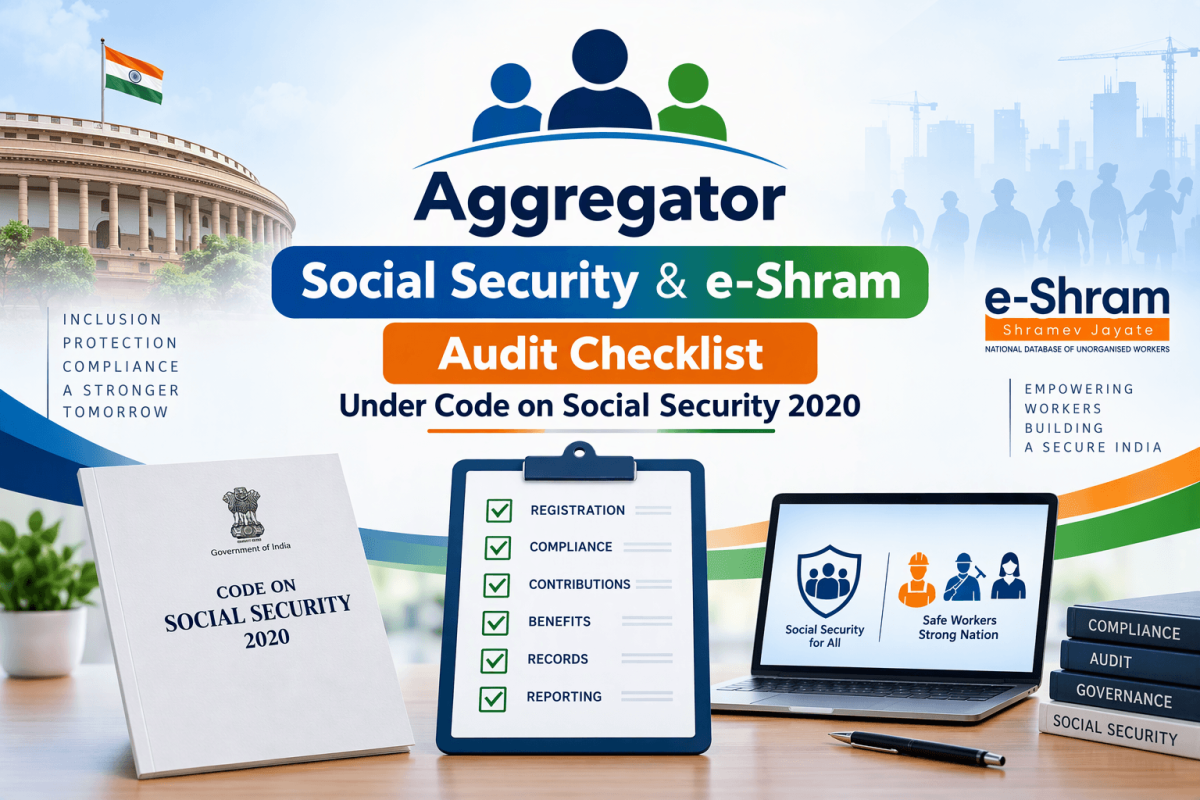
Navigating Active vs. Contingent Obligations Under the Code on Social Security, 2020
Digital platforms operating across ride-sharing, food delivery, quick-commerce, logistics, and e-marketplace sectors listed in the Seventh Schedule of the Code on Social Security, 2020 face a two-stage regulatory rollout. While the Social Security (Central) Rules, 2026 and Ministry of Labour and Employment (MoLE) advisories have operationalized digital registration and portal integration, the financial levy on aggregator turnover remains legally contingent upon a separate central notification.
Compliance and finance heads must structure their internal audits using this 5-Point Readiness Framework, carefully separating statutory obligations that are enforceable today from anticipatory financial provisioning.
The 5-Point Aggregator Governance and Audit Checklist
1. e-Shram API Partner Registration and UAN Seeding (Currently Operative Obligation)
Under Section 113 of the Code on Social Security, 2020, read with Rules 48 and 49 of the Social Security (Central) Rules, 2026 and the MoLE Aggregator Onboarding directives, every aggregator is currently required to register on the e-Shram Aggregator Module (aggregator.eshram.gov.in) and share partner database records.
- Audit Check: Verify whether the organisation has appointed a designated Single Point of Contact (SPOC) and completed Application Programming Interface (API) integration with the e-Shram portal.
- Operational Action: Ensure every active gig and platform partner is linked with a validated 12-digit Universal Account Number (UAN) on e-Shram. Configure backend systems to transmit periodic updates regarding new partner additions and permanent exits to maintain accurate portability data, and display the e-Shram UAN on partner digital identity cards.
2. Financial Modeling for the 1% to 2% Statutory Turnover Contribution (Anticipatory Planning for Contingent Levy)
Under Section 114(4) of the Code on Social Security, 2020, an aggregator’s contribution toward social security schemes for gig and platform workers is prescribed at a rate between 1 percent and 2 percent of annual turnover (excluding any tax, levy, and cess paid or payable to the Central Government), subject to a statutory cap of 5 percent of the amount paid or payable by the aggregator to gig and platform workers.
- Crucial Statutory Caveat Under Section 114(5): Under Section 114(4) and Section 114(5), this financial obligation takes effect only from such date and at such specific rate as the Central Government notifies in the Official Gazette. Because the exact percentage rate and commencement date have not yet been notified, no monetary cess is currently due or payable.
- Anticipatory Action: Treat financial provisioning as a proactive treasury exercise. Instruct finance and ERP teams to configure accounting ledgers that cleanly separate net entity turnover (excluding GST and central taxes/levies) from gross merchant settlements, and accurately track total annual payouts made to registered gig workers so the organisation can immediately compute the 5 percent payout cap once the notification under Section 114(5) is issued.
3. Auditing Algorithm-Driven Payout Disclosures (Governance Best Practice)
Disputes over sudden rate-card changes and automated penalty deductions frequently trigger union representations before Central and State labour authorities.
- Audit Check: Review partner terms of service and mobile application interfaces covering base delivery fees, distance incentives, surge multipliers, and order-cancellation deductions.
- Operational Action: Maintain auditable digital logs demonstrating that task allocation parameters and exact earning structures are disclosed to the partner before a task is accepted, and ensure rate-card revisions are communicated prospectively.
4. Formalizing Partner Grievance Redressal and Deactivation Appeals (Section 114(7)(f) Readiness)
Under Section 114(7)(f) of the Code, schemes framed for gig and platform workers may specifically provide for the resolution of grievances concerning the sharing of data and scheme administration. Furthermore, arbitrary automated ID blocking invites unfair practice challenges.
- Audit Check: Evaluate existing standard operating procedures for temporary suspension and permanent deactivation of partner accounts.
- Operational Action: Replace purely automated permanent blocking with a documented two-tier digital appeal mechanism involving human review, written reason codes, and defined response timelines. Display the national toll-free e-Shram helpline (14434 – 9.00 AM to 6.00 PM – Daily Including Sundays) inside the partner support tab for registration queries.
5. Field Fleet Accidental Safety and Insurance Readiness (Section 114(1) Alignment)
Because social security schemes contemplated under Section 114(1) prioritize life and disability cover, accidental insurance, and health benefits, operational safety directly impacts statutory risk.
- Audit Check: Inspect active group personal accident policies, delivery timer metrics, and emergency response workflows.
- Operational Action: Eliminate delivery time targets that incentivize traffic violations, verify valid driving licences during onboarding, maintain an in-app SOS emergency assistance button, and log all on-duty road accidents systematically to support seamless benefit claims.
Disclaimer: This free compliance checklist is prepared for general informational and operational readiness purposes for corporate compliance, finance, and legal teams. It does not substitute for specific legal advice or official notifications issued by the Ministry of Labour and Employment. Business entities should consult qualified legal counsel before altering statutory filings or financial disclosures.